
Mini Excavator Attachments: Buckets, Thumbs, Tilt Buckets and How to Check Fit
Mini excavator attachments explained: trenching, grading and tilt buckets, hydraulic thumbs and attachment sets, and the pin and span measurements that decide fit.
Affiliate disclosure: product links on this page go to Amazon or to the maker's own store. As an Amazon Associate we earn from qualifying purchases, at no extra cost to you; links to makers' own stores earn us nothing. No retailer or brand sees our picks before they are published or has any say in them. How we choose.
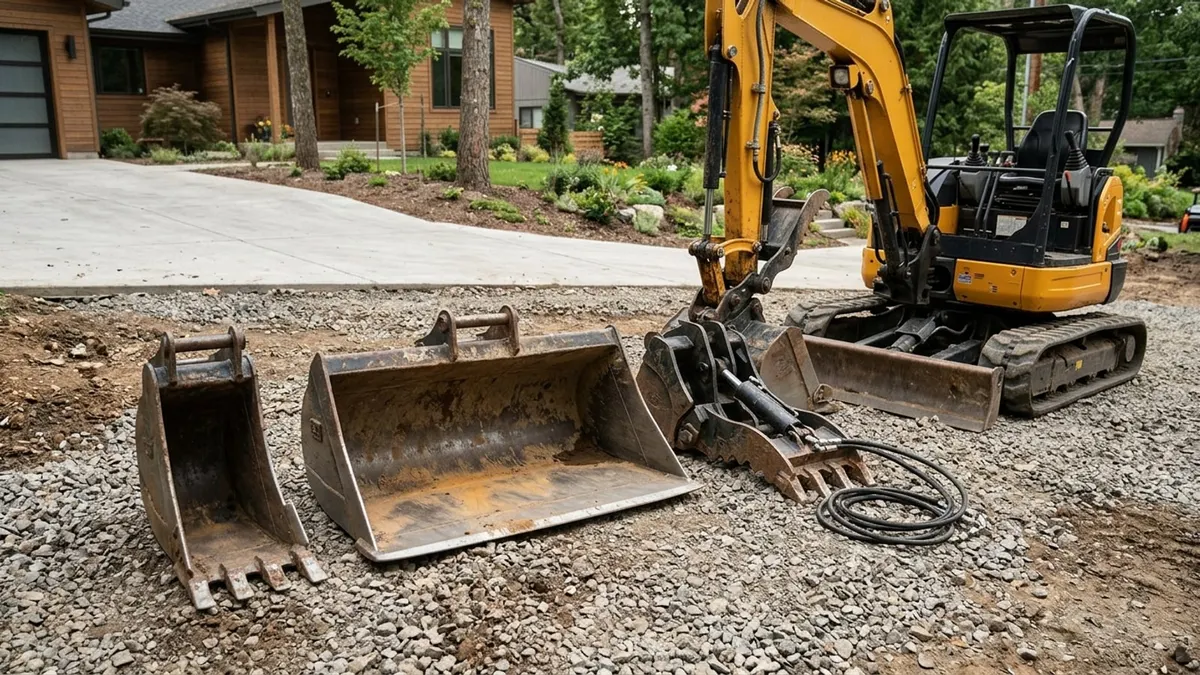
The attachments that matter most on a small excavator are a narrow trenching bucket, a wide flat grading bucket and a thumb. Before buying any, measure three things on your machine: the pin diameter, the span between the ears, and the distance between the two pin centers. Many 0.8 to 2 ton machines use 25 mm (0.98 in) pins with a 90 mm span, and the listings below all state those figures.
Our top picks at a glance
- Jecoupoon 200 mm trenching bucket
Type: 200 mm trenching bucket · Fit: 25 mm pins, 90 mm span and centers · Hydraulic: No · For: Pipe, drain and cable trenches
- MMS 500 mm flat grading bucket
Type: 500 mm flat (toothless) bucket · Fit: 0.8 to 1.8 ton; 25 mm pins, 90 mm span · Hydraulic: No · For: Grading, loose material
- DIGMIGHT 24 in hydraulic tilting bucket
Type: 600 mm hydraulic tilting bucket · Fit: 0.8 to 2 ton; 90 mm connection spacing · Hydraulic: Yes · For: Slopes, ditches, fine grading
- Hydraulic thumb kit for mini excavators up to 2 to 3 tons
Type: Hydraulic thumb · Fit: Machines up to 2 to 3 tons; 25 mm holes · Hydraulic: Yes · For: Rocks, logs, debris
- RELYMG 9-in-1 mini excavator attachment set
Type: 9-in-1 set · Fit: Most small to medium machines (listing) · Hydraulic: Thumb and auger · For: Owners who want everything at once
| Pick | Type | Fit | Hydraulic | For | Buy |
|---|---|---|---|---|---|
| Jecoupoon 200 mm trenching bucketBest trenching bucket | 200 mm trenching bucket | 25 mm pins, 90 mm span and centers | No | Pipe, drain and cable trenches | Amazon |
| MMS 500 mm flat grading bucketBest grading bucket | 500 mm flat (toothless) bucket | 0.8 to 1.8 ton; 25 mm pins, 90 mm span | No | Grading, loose material | Amazon |
| DIGMIGHT 24 in hydraulic tilting bucketBest tilt bucket | 600 mm hydraulic tilting bucket | 0.8 to 2 ton; 90 mm connection spacing | Yes | Slopes, ditches, fine grading | Amazon |
| Hydraulic thumb kit for mini excavators up to 2 to 3 tonsBest add-on thumb | Hydraulic thumb | Machines up to 2 to 3 tons; 25 mm holes | Yes | Rocks, logs, debris | Amazon |
| RELYMG 9-in-1 mini excavator attachment setBest attachment set | 9-in-1 set | Most small to medium machines (listing) | Thumb and auger | Owners who want everything at once | Amazon |
Best trenching bucket
Jecoupoon 200 mm trenching bucket
An 8 inch (200 mm) toothed bucket for narrow trenches, with its fit dimensions listed.
- Type
- 200 mm trenching bucket
- Fit
- 25 mm pins, 90 mm span and centers
- Hydraulic
- No
- For
- Pipe, drain and cable trenches
Pros
- Built-in teeth
- Fit dimensions stated
- Narrow trench, less backfill
Cons
- Check your machine's measurements first
The listing gives a 200 mm (7.87 in) width with built-in teeth, a 90 mm span, 25 mm (0.98 in) pin holes and a 90 mm center distance, for narrow trenches for pipes and drainage.
Best grading bucket
MMS 500 mm flat grading bucket
A 500 mm toothless bucket for leveling, loading gravel and cleaning ditches.
- Type
- 500 mm flat (toothless) bucket
- Fit
- 0.8 to 1.8 ton; 25 mm pins, 90 mm span
- Hydraulic
- No
- For
- Grading, loose material
Pros
- Smooth edge for leveling
- Pins and lock nuts included
Cons
- Not for digging hard ground
MMS lists a 500 mm (19.69 in) manganese steel bucket with no teeth, a 90 mm span, 25 mm pin holes and 90 mm centers, for 0.8 to 1.8 ton machines, with two pins and lock nuts included.
Best tilt bucket
DIGMIGHT 24 in hydraulic tilting bucket
A 24 inch hydraulic bucket that tilts 45 degrees each way for slopes and ditches.
- Type
- 600 mm hydraulic tilting bucket
- Fit
- 0.8 to 2 ton; 90 mm connection spacing
- Hydraulic
- Yes
- For
- Slopes, ditches, fine grading
Pros
- Tilts up to 45 degrees left and right
- Toothless flat edge
Cons
- Needs an auxiliary hydraulic circuit
DIGMIGHT lists a 600 mm (23.6 in) wide bucket that tilts up to 45 degrees each way under hydraulic control, with dimensions of 920 mm length, 630 mm structural span and 90 mm connection spacing, for 0.8 to 2 ton machines.
Best add-on thumb
Hydraulic thumb kit for mini excavators up to 2 to 3 tons
A hydraulic thumb kit with hoses and adapters for small machines with three arm holes.
- Type
- Hydraulic thumb
- Fit
- Machines up to 2 to 3 tons; 25 mm holes
- Hydraulic
- Yes
- For
- Rocks, logs, debris
Pros
- Two M14 hoses and M14 to M16 adapters included
- Manganese steel
Cons
- Listing says up to 2 tons in the title and 3 in the text
The listing describes a manganese steel hydraulic thumb with uneven teeth, two M14 hoses and two M14 to M16 adapters, for excavators with three holes in the arm and 25 mm (0.98 in) connection holes. It gives the size limit as up to 2 tons in the title and up to 3 tons in the text.
Best attachment set
RELYMG 9-in-1 mini excavator attachment set
Nine pieces in one box: buckets, thumb, quick coupler, ripper, rake, grapple and an 8 inch auger.
- Type
- 9-in-1 set
- Fit
- Most small to medium machines (listing)
- Hydraulic
- Thumb and auger
- For
- Owners who want everything at once
Pros
- Quick coupler included
- Ships from US warehouses
Cons
- Fit dimensions not stated in the listing
- Costs as much as several single pieces
RELYMG lists a 600 mm sieve bucket, quick coupler, ripper, rake, grapple, toolbox, 8 inch auger with hydraulic hose, 200 mm bucket and hydraulic thumb with hose, in manganese steel, stocked in the US. Confirm fit with the seller for your machine.
How we chose
We picked one attachment per job and favored listings that publish fit dimensions.
Measure before you buy
- Pin diameter (25 mm is common on small machines).
- Ear span: the inside width between the mounting ears (90 mm in these listings).
- Pin center distance: from one pin's center to the other's (90 mm on the Jecoupoon and MMS buckets).
A hydraulic attachment (thumb, tilt bucket, auger) also needs an auxiliary hydraulic circuit with compatible fittings.
Which attachments first
| Job | Attachment |
|---|---|
| Pipes, cables, drains | Narrow trenching bucket |
| Leveling, spreading gravel | Wide flat bucket |
| Slopes and ditches | Tilt bucket |
| Rocks, roots, brush | Thumb or grapple |
| Post holes, tree planting | Auger |
Bucket width by the job
The trench has to fit what goes in it. For a perimeter drain, the Concrete Masonry and Hardscapes Association's paving guide describes a 4 inch perforated pipe surrounded by at least 3 inches of open-graded stone, wrapped in geotextile. That is 10 inches across at the least (our arithmetic), so an 8 inch trenching bucket is too narrow for that detail and a 12 inch bucket is the size to look for. For a single water line or a conduit, the 200 mm bucket is the right tool: a narrower trench means less soil to move and less to put back.
The saving is easy to count. A trench 100 ft long and 3 ft deep is about 7.3 cubic yards with a 200 mm bucket and about 18 with a 500 mm one (our arithmetic). At Designing Buildings Wiki's indicative 1.25 short tons per cubic yard for loose subsoil, that is the difference between about 9 tons of spoil and about 23.
What a thumb and a tilt bucket change
A bucket alone can dig and carry loose material. A thumb closes against it so the machine can grip: rocks, stumps, logs, broken concrete. A mechanical thumb is set by hand at one angle; a hydraulic thumb moves with a lever and needs an auxiliary circuit. A tilt bucket turns up to 45 degrees each way on DIGMIGHT's model, so you can cut a ditch slope or a swale with the machine sitting level, which is otherwise done by repositioning the tracks for every pass.
Hydraulics: check before you order
Every hydraulic attachment needs three things from the machine: an auxiliary circuit, enough flow, and fittings that match. The thumb kit here ships with two M14 hoses and M14 to M16 adapters. Find out what thread your machine's auxiliary ports use, and whether it has a circuit free for each hydraulic attachment you plan to run. PWBULL lists its 1.8 ton machine's pump at 39 liters a minute; check an attachment's required flow against that figure before you buy it.
Breakers and dust
A hydraulic breaker on a mini excavator falls under OSHA's silica table as heavy equipment used to fracture silica-containing material. The control it lists is to operate from an enclosed cab, and to apply water or dust suppressant when anyone is working outside the cab. Of the machines in our mini excavator guide, only the MMS has an enclosed cab; on an open machine, plan on water at the point of breaking and keep other people well back.
Trenches people will stand in
A trenching bucket makes a narrow, straight-sided cut with nothing holding the walls. OSHA requires a protective system at 5 feet in workplaces and a way out within 25 feet at 4 feet, and says to keep spoil at least 2 feet from the edge. Bed and lay pipe from above where you can.
What to write down before ordering
Five measurements settle most fit questions: the pin diameter, the inside span between the ears, the distance between the two pin centers, the thread on your auxiliary hydraulic ports, and your machine's weight class. Compare them with the listing line by line. DIGMIGHT's tilt bucket, for one, gives a 920 mm length and a 630 mm structural span besides its 90 mm connection spacing. Where a listing contradicts itself, as the thumb kit does with 2 tons in its title and 3 in its text, ask the seller which is right and keep the answer.
Check what comes in the box as well. MMS includes two pins and lock nuts with its grading bucket; where a listing does not mention pins, ask before you order them separately.
Before digging
Call 811 a few business days ahead so buried lines are marked. More in 811 before you dig; machines in mini excavators.
Frequently asked questions
Are mini excavator attachments universal?
No. They are sold by pin diameter, ear span and pin center distance. Many small machines use 25 mm pins and a 90 mm span; measure yours before buying.
What attachments do I need for a mini excavator?
Start with the bucket that came with it, a narrow trenching bucket and a wide flat bucket. Add a thumb if you move rocks, logs or debris.
Do I need auxiliary hydraulics for a thumb?
For a hydraulic thumb, tilt bucket or auger, yes: it needs a hydraulic circuit and matching fittings. Mechanical thumbs do not.
What is a tilt bucket for?
Grading slopes and cleaning ditches without repositioning the machine. DIGMIGHT's 24 inch bucket tilts up to 45 degrees each way.
How wide a bucket do I need for a French drain?
The paver industry's guide describes a 4 inch perforated pipe with at least 3 inches of stone around it, which is 10 inches across at the least. An 8 inch (200 mm) bucket is too narrow for that; look for 12 inches.
Sources
- 811 Before You Dig, Common Ground Alliance
- Trenching and Excavation Safety fact sheet, OSHA
- PAV-TEC-002: Construction of Interlocking Concrete Pavements, Concrete Masonry and Hardscapes Association
- 29 CFR 1926.1153, Respirable crystalline silica (Table 1), OSHA
- 29 CFR 1926.651, Specific excavation requirements, OSHA
- Converting between weight and volume for bulk construction materials, Designing Buildings Wiki
Cover image: Illustration: Construction Gear Review (AI-generated)
Related guides
Buying an Imported Mini Excavator Online: What to Check Before You Order
Engine, emissions, warranty, parts, freight and fit: the checks that separate a good import from an expensive yard ornament.
Mini Excavators for Property Owners: The 1 to 2 Ton Machines Sold Online (2026)
Five small excavators sold online, what each listing actually commits to, and what to check before you order one.
Towable Backhoes: What They Dig, What They Need and Which to Buy
A self-powered backhoe on a trailer, or one for your tractor: how they compare with a mini excavator.