
Call 811 Before You Dig: How It Works and What the Marks Mean for You
Call 811 before you dig: what the free service does, how far ahead to contact it, waiting for every utility to respond, digging near the marks, and trench safety.
Affiliate disclosure: product links on this page go to Amazon or to the maker's own store. As an Amazon Associate we earn from qualifying purchases, at no extra cost to you; links to makers' own stores earn us nothing. No retailer or brand sees our picks before they are published or has any say in them. How we choose.
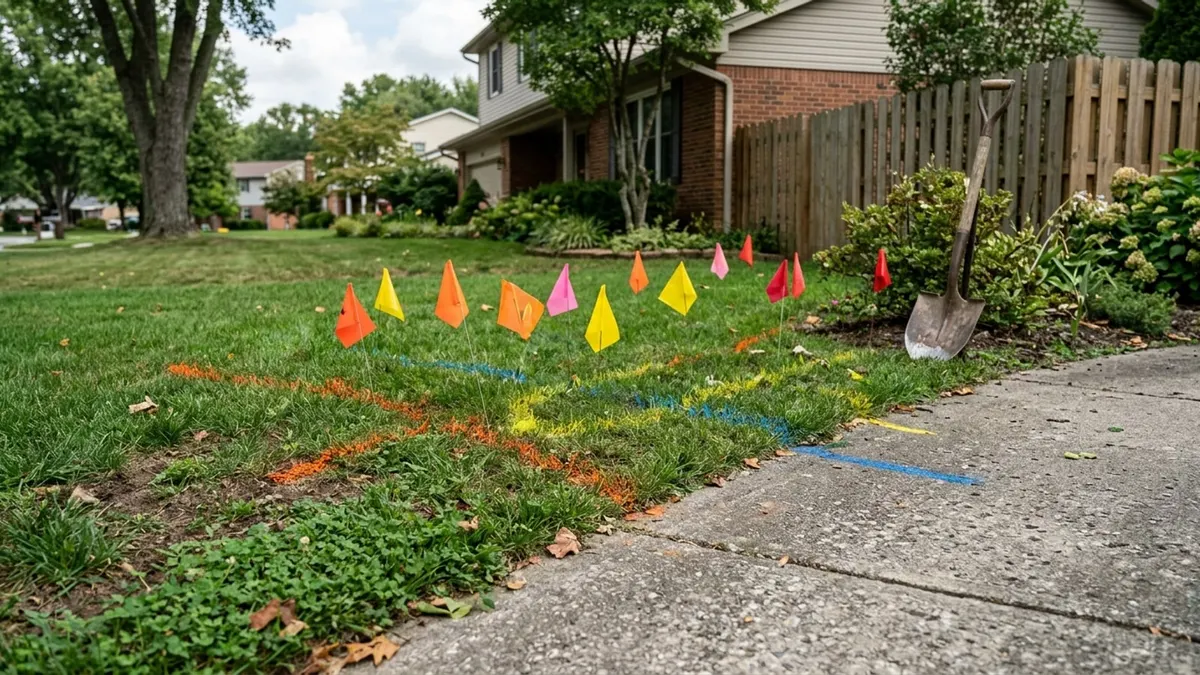
811 is the free national before-you-dig service. Contact it a few business days before any digging (a fence post, a tree, a mailbox, a trench), and the utilities in your area mark the approximate location of their buried lines with paint or flags. Wait until every utility has responded before you break ground, and dig carefully around the marks. The service is a Common Ground Alliance initiative.
How it works
- Contact 811 by phone or your state's online request a few business days before you dig.
- Describe the dig site and the work.
- Utilities respond and mark the approximate location of their buried lines with paint or flags. This takes a few days.
- Confirm every utility has responded before breaking ground.
- Dig carefully around the marks. Consider moving the project if it sits close to buried lines.
What to have ready
811 says you will be asked for the address where you plan to dig, including the county and the nearest cross street, the type of project, and the exact area on the property where the digging will be.
Why the wait matters
811 puts the cost of damage to buried utilities in the United States at about $30 billion a year in repairs and wider effects. The service asks for a few business days because each utility has to send someone. The paver industry's construction guide tells its own contractors the same thing, noting that many localities have one number to call at least two days before excavating. The step people skip is the last one: confirm that every utility has responded, not just the first to show up with a can of paint.
What 811 does not cover
Utility marks show the utilities' lines. Private lines you or a previous owner installed (a line to a shed, a sprinkler system, a private gas line to a grill) are usually yours to locate. Ask your state's 811 center what it covers.
Every kind of digging counts
811 lists tree planting, fencing and mailbox installation among the jobs to call for. Powered augers, trenchers and excavators find buried cables much faster than a shovel does: see post hole diggers, trenchers and mini excavators.
Digging near the marks
The marks show the approximate location of a line, not its exact position or depth. OSHA's excavation rule for workplaces deals with that directly: when digging approaches the estimated location of an underground installation, its exact location has to be found by safe and acceptable means before the work goes on. For a homeowner that means exposing the line by hand before a powered auger, trencher or bucket goes near it. 811's own advice is to dig carefully around the marks and to consider moving a project that sits close to buried lines.
Look up as well
Buried lines are not the only ones. The paver industry's construction guide tells contractors to check overhead clearances before work starts, so that equipment does not touch wires. A mini excavator's boom and a towable backhoe both reach higher than they look. Check what is above the dig as well as below it.
OSHA's excavation rule also asks for a warning system, such as barricades or stop logs, wherever a machine works close to an edge its operator cannot see clearly.
Trench safety
OSHA calls trench collapses the greatest risk to workers in trenching. Its rules for workplaces are a sound guide at home:
- Trenches 5 feet deep or more need a protective system (sloping, benching, shoring or a trench box) unless dug entirely in stable rock; 20 feet or more need an engineer's design.
- Keep excavated soil and materials at least 2 feet from the trench edge.
- Keep heavy equipment away from trench edges.
- Know where underground utilities are before digging.
- Inspect after rain or anything that could change conditions.
How steep a trench wall may be
OSHA's sloping table gives the steepest wall allowed for each soil type in an excavation under 20 feet deep. In Type A soil the slope is 3/4 horizontal to 1 vertical, about 53 degrees. In Type B it is 1 to 1, or 45 degrees. In Type C, the weakest, it is 1-1/2 to 1, about 34 degrees. Classifying soil is a job for a trained person. Without one, plan for Type C: by our arithmetic a trench 4 feet deep sloped that way is cut back 6 feet on each side.
Getting out, and water
The same rule requires a ladder, stairway or ramp in any trench 4 feet or more deep, placed so that nobody has to travel more than 25 feet sideways to reach it. It bars work in a trench where water has collected or is collecting unless precautions have been taken. The fact sheet adds testing the air in trenches deeper than 4 feet where there could be low oxygen or fumes, and inspecting again after rain.
The four protective systems
OSHA's fact sheet names them. Sloping cuts the wall back at an angle. Benching cuts it into steps, and is not allowed in Type C soil. Shoring braces the walls with hydraulic or other supports. Shielding puts a trench box around the people working. A homeowner's version of all four is to keep the trench shallow, keep people out of it, and hire the work out before a trench reaches the depths where those rules start, 4 to 5 feet.
Never stand in a trench that could cave in. Soil is heavy and collapses without warning.
Frequently asked questions
Is calling 811 free?
Yes. 811 describes itself as the free national before-you-dig service.
How far ahead should I call 811?
A few business days before you begin any digging, so utilities have time to mark their lines.
Do I need to call 811 to plant a tree or dig fence posts?
Yes. 811 names tree planting, fencing and mailbox installation among the projects to call for.
Does 811 mark private lines?
Utilities mark their own lines. Private lines such as a line to a shed or a sprinkler system are usually the owner's to locate; ask your state 811 center.
How deep can I dig a trench safely?
OSHA requires protective systems for trenches 5 feet deep or more in workplaces and calls cave-ins the greatest risk. Never enter a trench that could collapse.
Sources
- 811 Before You Dig, Common Ground Alliance
- Trenching and Excavation Safety fact sheet, OSHA
- Trenching and Excavation, OSHA
- 29 CFR 1926.651, Specific excavation requirements, OSHA
- 29 CFR 1926 Subpart P Appendix B, Sloping and benching, OSHA
- PAV-TEC-002: Construction of Interlocking Concrete Pavements, Concrete Masonry and Hardscapes Association
Cover image: Illustration: Construction Gear Review (AI-generated)
Related guides
Construction Equipment for Homeowners: What to Buy or Rent for Each Project
Start from the project: the machine it needs, whether to own it, and the guide that sizes it.
Rent or Buy a Mini Excavator? How to Decide for Your Property
A simple way to decide: count the days of digging, then add hauling, storage and upkeep to the purchase.
Silica Dust When Cutting or Breaking Concrete: How to Protect Yourself
Why concrete dust is dangerous, and the water, vacuum and respirator steps OSHA's standard is built on.