
Electric Post Hole Diggers: Corded Augers for Fences and Planting (2026)
The best electric post hole diggers: corded 1,200 to 1,500 W augers compared on speed, torque, bit size, depth, reverse and safety switches, from the listings.
Affiliate disclosure: product links on this page go to Amazon or to the maker's own store. As an Amazon Associate we earn from qualifying purchases, at no extra cost to you; links to makers' own stores earn us nothing. No retailer or brand sees our picks before they are published or has any say in them. How we choose.
For fence posts and planting within reach of an outlet, the electric digger to buy is the XtremepowerUS 1500 W with reverse: reverse rotation frees a bit stuck in compacted soil or roots, which is the usual way electric augers get stuck. The VEVOR 1500 W lists the deepest reach here at 36.4 inches.
Electric augers are quieter and need no fuel, but most come with a 6 inch bit and suit lighter soils better than gas diggers.
Our top picks at a glance
- XtremepowerUS 1500 W electric post hole digger with reverse
Motor: 1,500 W · Bit: 6 in, 3/4 in shaft · Depth: Not stated · Extras: Forward and reverse
- VEVOR 1500 W electric post hole digger
Motor: 1,500 W, 140 rpm · Bit: 5.7 in blade · Depth: 36.4 in (925 mm) · Extras: 10.24 in extension, safety lock
- XtremepowerUS 1500 W electric post hole digger
Motor: 1,500 W, 10.9 A · Bit: 6 in manganese steel · Depth: About 28 in · Extras: Safety lock, anti-skid grips
- Auoncoe electric post hole digger (33 ft cord)
Motor: 1,200 W · Bit: 6 x 31.5 in · Depth: Bit length 31.5 in · Extras: 33 ft cord, speed adjustment
| Pick | Motor | Bit | Depth | Extras | Buy |
|---|---|---|---|---|---|
| XtremepowerUS 1500 W electric post hole digger with reverseBest overall | 1,500 W | 6 in, 3/4 in shaft | Not stated | Forward and reverse | Amazon |
| VEVOR 1500 W electric post hole diggerDeepest reach | 1,500 W, 140 rpm | 5.7 in blade | 36.4 in (925 mm) | 10.24 in extension, safety lock | Amazon |
| XtremepowerUS 1500 W electric post hole diggerMost torque listed | 1,500 W, 10.9 A | 6 in manganese steel | About 28 in | Safety lock, anti-skid grips | Amazon |
| Auoncoe electric post hole digger (33 ft cord)Longest cord | 1,200 W | 6 x 31.5 in | Bit length 31.5 in | 33 ft cord, speed adjustment | Amazon |
A 1,500 W auger with reverse to back a stuck bit out of the hole.
- Motor
- 1,500 W
- Bit
- 6 in, 3/4 in shaft
- Depth
- Not stated
- Extras
- Forward and reverse
Pros
- Reverse frees a jammed bit
- Fence, trellis, sign and planting holes
Cons
- 6 inch bit only
XtremepowerUS lists a 1,500 W motor, forward and reverse rotation to release the bit when it sticks in compacted soil or roots, a 6 inch auger bit and a 3/4 inch shaft.
Deepest reach
VEVOR 1500 W electric post hole digger
A 1,500 W, 140 rpm auger rated for holes 5.9 inches wide and 36.4 inches deep.
- Motor
- 1,500 W, 140 rpm
- Bit
- 5.7 in blade
- Depth
- 36.4 in (925 mm)
- Extras
- 10.24 in extension, safety lock
Pros
- Extension rod included
- Safety lock against accidental starts
Cons
- Narrow 5.9 inch hole
VEVOR lists a 1,500 W motor at 140 rpm, a 5.7 inch blade drilling holes up to 5.91 inches wide and 36.42 inches deep, a 10.24 inch extension rod, a coated alloy steel bit and a security lock against accidental startup.
Most torque listed
XtremepowerUS 1500 W electric post hole digger
A 1,500 W auger the maker rates at 90 ft-lb of torque, with a 28 inch dig depth.
- Motor
- 1,500 W, 10.9 A
- Bit
- 6 in manganese steel
- Depth
- About 28 in
- Extras
- Safety lock, anti-skid grips
Pros
- Torque and speed listed
- Two vibration-damped grips
Cons
- No reverse on this model
The listing gives a 1,500 W, 10.9 amp motor delivering 90 ft-lb of torque at 270 rpm, a 6 inch manganese steel bit digging about 28 inches deep, a safety lock and two anti-skid, vibration-proof grips.
Longest cord
Auoncoe electric post hole digger (33 ft cord)
A corded auger with a 33 ft grounded cord, dual start switches and a 31.5 inch bit.
- Motor
- 1,200 W
- Bit
- 6 x 31.5 in
- Depth
- Bit length 31.5 in
- Extras
- 33 ft cord, speed adjustment
Pros
- 33 ft 3-prong grounded cord
- Starts only with both switches pressed
Cons
- Smaller motor
Auoncoe lists a 1,200 W copper motor, a 33 ft power cord with a 3-prong grounded plug, a safety lock that runs only with both switches pressed, speed adjustment, and a 6 by 31.5 inch alloy steel bit.
How we chose
We compared motor power, speed and torque where listed, bit size and depth, reverse and safety features.
Electric or gas?
| Electric | Gas | |
|---|---|---|
| Fuel and starting | Plug in and pull the trigger | Mixed fuel, pull start |
| Noise and fumes | Quieter, no exhaust | Loud, exhaust |
| Bits | Mostly 6 in | 6 to 12 in |
| Reach | Limited by the cord | Anywhere |
| Hard ground | Struggles in clay and rock | Better, especially 52cc and up |
For long fence lines or wide holes, see gas post hole diggers.
Cords and safety
- Use a heavy-gauge outdoor extension cord rated for the tool's current, plugged into a GFCI-protected outlet.
- Keep both hands on the grips: a bit that catches can twist the tool.
- Call 811 a few business days before digging so buried lines are marked.
What a 6 inch hole is good for
Quikrete's rule for a post set in concrete is a hole about three times the post's diameter. Turn that around and a 6 inch bit suits a post about 2 inches across: steel fence posts, sign posts, trellis and mailbox posts, and planting. A wooden 4x4 measures 3.5 inches, so the rule asks for a hole of about 10 inches, which no electric auger on this page drills in one pass. A 4x4 will go into a 6 inch hole, but with about an inch of concrete around it instead of three.
That is the real dividing line between electric and gas. If the fence is chain link or welded wire on steel posts, an electric auger is the right size. If it is a privacy fence on 4x4s, look at the 8 and 10 inch bits on the gas diggers, or use the electric auger for a pilot hole and widen it by hand.
Depth against fence height
Quikrete gives the depth two ways that come to the same thing: a third of the post's overall length, or half its height above ground. By our arithmetic, the 28 inch depth XtremepowerUS lists is enough for a post standing 56 inches out of the ground, Auoncoe's 31.5 inch bit for one standing 63 inches, and VEVOR's 36.4 inches for a full 6 ft fence. Check the listed depth against the fence you are building before you check the wattage.
What the motor draws
A 1,500 W motor at 120 V draws 12.5 amps and a 1,200 W motor 10 amps (our arithmetic); XtremepowerUS lists 10.9 amps for its 1,500 W model without reverse. Either way these tools sit inside a 15 amp household circuit, with little to spare for anything else on it. The length of cord between the outlet and the last post is the practical limit: measure the run before you buy.
Near the marks, put the auger down
811 marks show the approximate position of a line. OSHA's excavation rule for workplaces says that when digging approaches the estimated location of an underground installation, its exact location must be found by safe and acceptable means, and 811's own advice is to dig carefully around the marks. For a fence line that crosses a marked line, dig the nearest holes with a manual digger, or move the post.
Concrete for the holes it drills
A 6 inch hole 24 inches deep holds about 0.39 cubic feet, which is one 80 lb bag of Quikrete Concrete Mix or one 60 lb bag of its fast-setting mix. The fast-setting sheet describes a method with no mixing: stand the post, pour the dry mix to within 3 to 4 inches of the top, and add about 1-1/4 gallons of water per bag. For other sizes see concrete per fence post.
A fence line in numbers
A 100 ft fence with posts every 8 ft has 13 spans and 14 posts. With a 6 inch bit and 24 inch holes, each hole brings up about 0.39 cubic feet of soil, so the whole line is about 5.5 cubic feet, a few wheelbarrow loads, and takes 14 bags of 80 lb mix at one bag a hole (our arithmetic from Quikrete's yield). The same fence on 4x4s in 10 inch holes 30 inches deep is about 19 cubic feet of soil and 42 bags. The post you choose decides the size of the job more than the tool does.
What 811 will ask
Contact 811 a few business days before you drill. It will want the address, the county and nearest cross street, the kind of project, and the exact part of the property where the holes will go, so walk the fence line first and know where it starts and ends. Then wait: 811 says to make sure every utility has responded before you break ground. An electric auger finds a buried cable just as easily as a gas one.
Allow for the wait as well. Quikrete says a post set in its regular mix should take no strain for 24 hours; with the fast-setting mix the wait before heavy loads is 4 hours.
Frequently asked questions
Are electric post hole diggers any good?
For 6 inch holes in ordinary soil near an outlet, yes: they are quieter and need no fuel. Gas augers are better for wide holes, clay and long fence lines.
How deep can an electric auger dig?
Listings vary: VEVOR rates its 1,500 W digger for holes up to 36.4 inches deep, and XtremepowerUS gives about 28 inches for its model.
Why does reverse matter on an auger?
A bit that jams on roots or compacted soil can be backed out in reverse instead of being wrestled out. XtremepowerUS sells a 1,500 W model with reverse.
What extension cord do I need for an electric auger?
A heavy-gauge outdoor cord rated for the tool's amperage, plugged into a GFCI-protected outlet. Check the tool's manual for the minimum gauge.
Can an electric auger dig holes for 4x4 posts?
Not at the size Quikrete recommends. Its rule is a hole about three times the post's diameter, about 10 inches for a 4x4 that measures 3.5 inches, and the electric augers here drill about 6 inches. They suit steel posts about 2 inches across, or pilot holes you widen by hand.
Sources
- 811 Before You Dig, Common Ground Alliance
- Concrete Mix No. 1101 data sheet, Quikrete
- 29 CFR 1926.651, Specific excavation requirements, OSHA
- Fast-Setting Concrete Mix No. 1004-60 data sheet, Quikrete
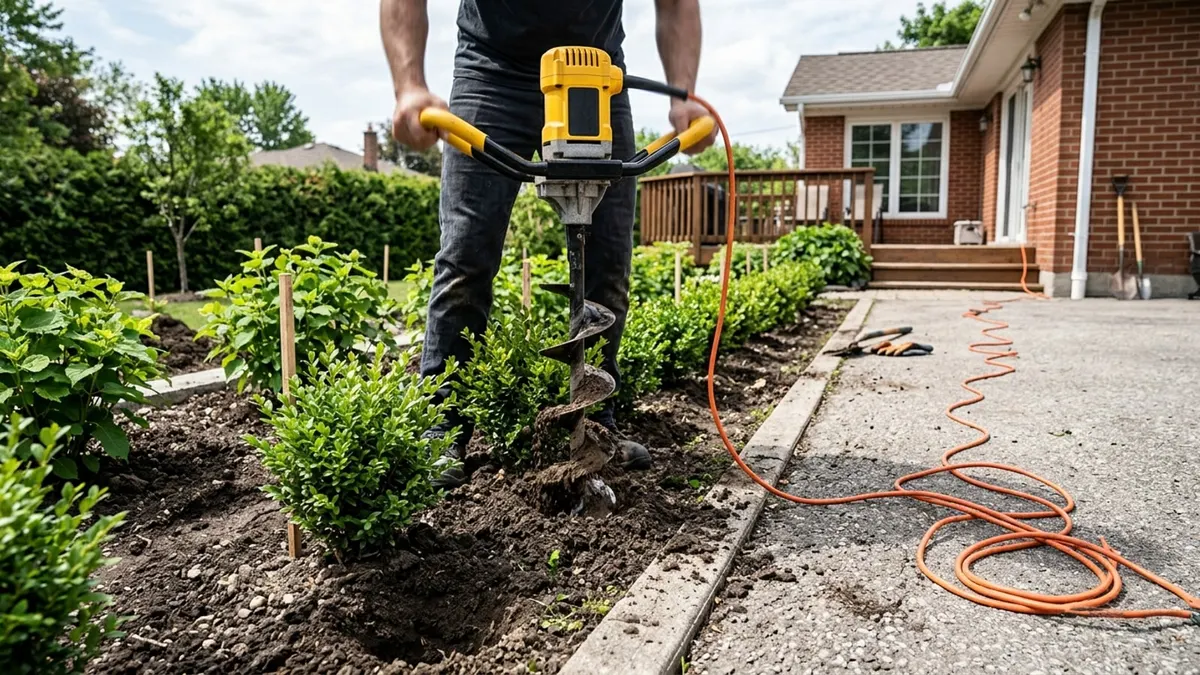
Cover image: Illustration: Construction Gear Review (AI-generated)
Related guides
Gas Post Hole Diggers: The Best Earth Augers for Fences and Decks (2026)
Five gas augers from a 43cc one-person powerhead to a 72cc digger, plus which bits come in the box.
How Much Concrete per Fence Post: Bags by Hole Size and Depth
Bag counts for common post hole sizes, and why the post itself saves you a little concrete.
Manual Post Hole Diggers: Clamshell Diggers and Hand Augers (2026)
For a handful of posts, a good clamshell digger or hand auger beats renting a machine.