
Gas Post Hole Diggers: The Best Earth Augers for Fences and Decks (2026)
The best gas post hole diggers and earth augers for fences and decks: one-person and two-person powerheads compared on engine, bits and warranty.
Affiliate disclosure: product links on this page go to Amazon or to the maker's own store. As an Amazon Associate we earn from qualifying purchases, at no extra cost to you; links to makers' own stores earn us nothing. No retailer or brand sees our picks before they are published or has any say in them. How we choose.
For most fence and deck jobs, the gas post hole digger to buy is the Earthquake E43: a one-person 43cc powerhead with a 30:1 transmission, an 8 inch by 36 inch bit and a 5-year limited warranty. On a budget, the VEVOR 52cc digger comes with 6 and 10 inch bits and three extensions.
Call 811 a few business days before you drill; augers find buried cables faster than shovels do.
Our top picks at a glance
- Earthquake E43 one-person auger (43cc)
Engine: 43cc 2-cycle Viper · Bits included: 8 x 36 in · Operators: 1 · Warranty: 5-year limited
- VEVOR D52-F 52cc gas post hole digger
Engine: 52cc 2-stroke, up to 9,350 rpm · Bits included: 6 in and 10 in, 3 extensions · Operators: 1 · Warranty: Not stated
- NEO-TEC 72cc gas post hole digger
Engine: 72cc 2-stroke · Bits included: 6, 8 and 10 in, 3 extensions · Operators: 1 · Warranty: Not stated
4. Best one or two-person powerhead
Earthquake Dually 10310 one or two-person powerhead (52cc)Engine: 52cc 2-cycle Viper · Bits included: None (fits 2 to 10 in) · Operators: 1 or 2 · Warranty: 5-year quality guarantee
- PROYAMA 54cc gas post hole digger
Engine: 54cc 2-stroke, 2.4 hp · Bits included: 4, 6, 8 and 12 in; 12 and 20 in extensions · Operators: 1 · Warranty: Not stated
| Pick | Engine | Bits included | Operators | Warranty | Buy |
|---|---|---|---|---|---|
| Earthquake E43 one-person auger (43cc)Best overall | 43cc 2-cycle Viper | 8 x 36 in | 1 | 5-year limited | Amazon |
| VEVOR D52-F 52cc gas post hole diggerBest budget | 52cc 2-stroke, up to 9,350 rpm | 6 in and 10 in, 3 extensions | 1 | Not stated | Amazon |
| NEO-TEC 72cc gas post hole diggerMost power | 72cc 2-stroke | 6, 8 and 10 in, 3 extensions | 1 | Not stated | Amazon |
| Earthquake Dually 10310 one or two-person powerhead (52cc)Best one or two-person powerhead | 52cc 2-cycle Viper | None (fits 2 to 10 in) | 1 or 2 | 5-year quality guarantee | Amazon |
| PROYAMA 54cc gas post hole diggerMost bits included | 54cc 2-stroke, 2.4 hp | 4, 6, 8 and 12 in; 12 and 20 in extensions | 1 | Not stated | Amazon |
Best overall
Earthquake E43 one-person auger (43cc)
A 43cc one-person auger with a long 36 inch bit and the best warranty here.
- Engine
- 43cc 2-cycle Viper
- Bits included
- 8 x 36 in
- Operators
- 1
- Warranty
- 5-year limited
Pros
- 30:1 ball-bearing transmission
- Long bit lets you start standing upright
Cons
- One bit only
- Smaller engine than the 52 to 72cc diggers
Earthquake lists a 43cc Viper 2-cycle engine, industrial air filtration, steel welded handlebars, a transmission with ball bearings and alloy gears, anti-vibration foam grips, and an 8 inch auger 36 inches long with a fishtail point, a Flex Coil shock absorber and replaceable blades. Ardisam, Earthquake's maker, lists a 30:1 transmission for the E43. Warranty: 5-year limited.
Best budget
VEVOR D52-F 52cc gas post hole digger
A 52cc digger with two bit sizes and three extensions in the box.
- Engine
- 52cc 2-stroke, up to 9,350 rpm
- Bits included
- 6 in and 10 in, 3 extensions
- Operators
- 1
- Warranty
- Not stated
Pros
- Two bits plus extensions
- EPA listed, per VEVOR
Cons
- No warranty on the listing
- 40:1 fuel mix to measure
VEVOR lists a 52cc engine at up to 9,350 rpm, a gearbox with ball-bearing shafts and alloy gears, a 0.32 gallon tank, a 31.5 inch bit with a 7.8 inch extension, a quick shutoff switch, and 6 and 10 inch bits with three extension rods, a spark plug, oil can and tools. It runs on a 1:40 oil-to-gas mix and is EPA listed, per the listing.
Most power
NEO-TEC 72cc gas post hole digger
A 72cc digger for clay and frozen ground, with 6, 8 and 10 inch bits.
- Engine
- 72cc 2-stroke
- Bits included
- 6, 8 and 10 in, 3 extensions
- Operators
- 1
- Warranty
- Not stated
Pros
- Big engine for hardpan and roots
- Doubles as an ice auger
Cons
- Not CARB certified, by NEO-TEC's listing for its 8 and 12 inch kit
- 17.6 lb powerhead is heavier
NEO-TEC lists a 72cc 2-stroke engine on a 25:1 mix, 6, 8 and 10 inch bits on a 7/8 inch shaft, three 8 inch extensions, anti-vibration handles and a 17.6 lb weight. Its listing for the same 72cc powerhead with 8 and 12 inch bits states plainly that it is not CARB certified and cannot be sold or shipped to California; the listing for this kit leaves that line out.
Best one or two-person powerhead
Earthquake Dually 10310 one or two-person powerhead (52cc)
A 52cc powerhead with throttles for one operator or two, for 2 to 10 inch bits.
- Engine
- 52cc 2-cycle Viper
- Bits included
- None (fits 2 to 10 in)
- Operators
- 1 or 2
- Warranty
- 5-year quality guarantee
Pros
- Two throttle positions
- Centrifugal clutch slips on sudden impact
Cons
- Bits sold separately
Earthquake lists jobsite handlebars that protect the engine, a centrifugal clutch that slips on sudden impact to reduce fatigue, two handlebar throttles for one or two-person use, a five-bearing steel-gear transmission and a 5-year quality guarantee. It fits bits from 2 to 10 inches; none are included.
Most bits included
PROYAMA 54cc gas post hole digger
A 54cc digger with four bit sizes and two extensions.
- Engine
- 54cc 2-stroke, 2.4 hp
- Bits included
- 4, 6, 8 and 12 in; 12 and 20 in extensions
- Operators
- 1
- Warranty
- Not stated
Pros
- Four bits cover planting to deck footings
- Ball-bearing gearbox
Cons
- 12 inch bit is a lot for one person in hard soil
PROYAMA lists a 54cc 2.4 hp engine, 4, 6, 8 and 12 inch bits, 12 and 20 inch extension rods, an easy-start system and a gearbox with ball-bearing shafts and alloy gears.
How we chose
We compared engine size, the bits and extensions in the box, one or two-person use and warranty, from the makers' listings.
Buying guide
Engine size
43 to 52cc one-person augers handle 6 to 8 inch holes in ordinary soil. 72cc engines push harder through clay and roots. Large bits (10 inches and up) and hard ground are where two-person powerheads earn their keep; see one-man vs two-man augers.
Bit size
Many fence builders use a hole about three times the post width. A 6 inch bit suits small posts and planting; 8 to 10 inch bits suit 4x4 fence posts; 12 inch bits suit deck footings. Concrete per hole is in concrete per fence post.
Kickback
An auger that hits a root or rock can twist the handles hard. Clutches that slip on impact (Earthquake's Dually) help; keep a firm stance and never wrap the handles around your body.
| Digger | Engine | Bits |
|---|---|---|
| Earthquake E43 | 43cc | 8 in |
| VEVOR D52-F | 52cc | 6, 10 in |
| NEO-TEC | 72cc | 6, 8, 10 in |
| Earthquake Dually | 52cc | None |
| PROYAMA | 54cc | 4, 6, 8, 12 in |
Other options
No gas mix to deal with? See electric post hole diggers. A few holes only? A manual digger may do.
Always call 811 first: the free service marks buried lines a few business days after you contact it. See 811 before you dig.
Bit size by the post
Quikrete's rule for a post set in concrete is a hole about three times the post's diameter. A 4x4 measures 3.5 inches, so it wants a hole of about 10 inches: the 10 inch bit in the VEVOR and NEO-TEC kits, or the E43's 8 inch bit for a slightly tighter fit. A 6x6 measures 5.5 inches and by the same rule wants more than 16 inches, which is beyond any one-person auger here; those holes are dug with a 12 inch bit and widened by hand, or with a machine.
Depth and extensions
The same data sheet puts the depth at a third of the post's overall length. A 6 ft fence on 9 ft posts needs 3 ft holes. The E43's bit is 36 inches long, which reaches that without an extension. VEVOR lists a 31.5 inch bit with a 7.8 inch extension, and PROYAMA includes 12 and 20 inch extensions. If your frost depth or your fence height calls for more than the bit alone, check that the kit's extension gets you there.
Fuel
These are two-stroke engines and each maker sets its own mix: VEVOR lists 40 parts gas to 1 of oil, NEO-TEC 25 to 1. Use the ratio in the manual for the tool you buy, not the can you already have mixed for something else. Ardisam, which makes Earthquake, also lists two-person powerheads with four-cycle Briggs and Stratton, Honda and Kohler engines, which take straight gasoline, and a 60 volt battery powerhead.
California and other limits
California regulates spark-ignition engines of 19 kilowatts or less as small off-road engines, a class every auger here falls in, and some are not certified for sale there. NEO-TEC says so plainly for its 72cc digger. If you are in California, look for the CARB statement on the listing before you compare anything else.
Before the first hole
Contact 811 a few business days ahead with the address, the nearest cross street and where on the property you will dig, and wait until every utility has responded. The marks are approximate. OSHA's excavation rule says the exact location of a line has to be found by safe means when digging gets close to it, so the holes next to a mark are dug by hand, not with the auger. Plan where the soil goes too: a 10 inch hole 30 inches deep brings up about 1.36 cubic feet, so 14 holes make about 0.7 of a cubic yard (our arithmetic).
Have the concrete on site before you drill. A 10 inch hole 30 inches deep takes three 80 lb bags of Quikrete Concrete Mix, and Quikrete's Fast-Setting mix can be poured in dry around the post and watered in the hole, about 1-1/4 gallons per 60 lb bag. Counts for other sizes are in concrete per fence post.
Frequently asked questions
What size auger do I need for fence posts?
An 8 to 10 inch bit suits 4x4 fence posts; a 6 inch bit suits small posts and planting. Check the fence maker's instructions for hole size.
Is a one-person or two-person auger better?
One-person augers suit 6 to 8 inch holes in ordinary soil. Two-person powerheads give more control with big bits and hard ground.
Can a gas post hole digger go through clay?
Larger engines help: NEO-TEC markets its 72cc digger for hardpan clay, roots and frozen ground. Clear the hole often and expect slower progress.
Which gas post hole diggers can ship to California?
Check CARB compliance on the listing. NEO-TEC states its 72cc digger is not CARB certified and cannot ship to California.
Do I need to call 811 before using an auger?
Yes. Contact 811 a few business days before digging and wait for all utilities to mark their lines.
Sources
- E43 1-Man Earth Auger with 8 Inch Auger Bit, Ardisam (Earthquake)
- 811 Before You Dig, Common Ground Alliance
- Concrete Mix No. 1101 data sheet, Quikrete
- Small Off-Road Engines (SORE), California Air Resources Board
- 29 CFR 1926.651, Specific excavation requirements, OSHA
- Fast-Setting Concrete Mix No. 1004-60 data sheet, Quikrete
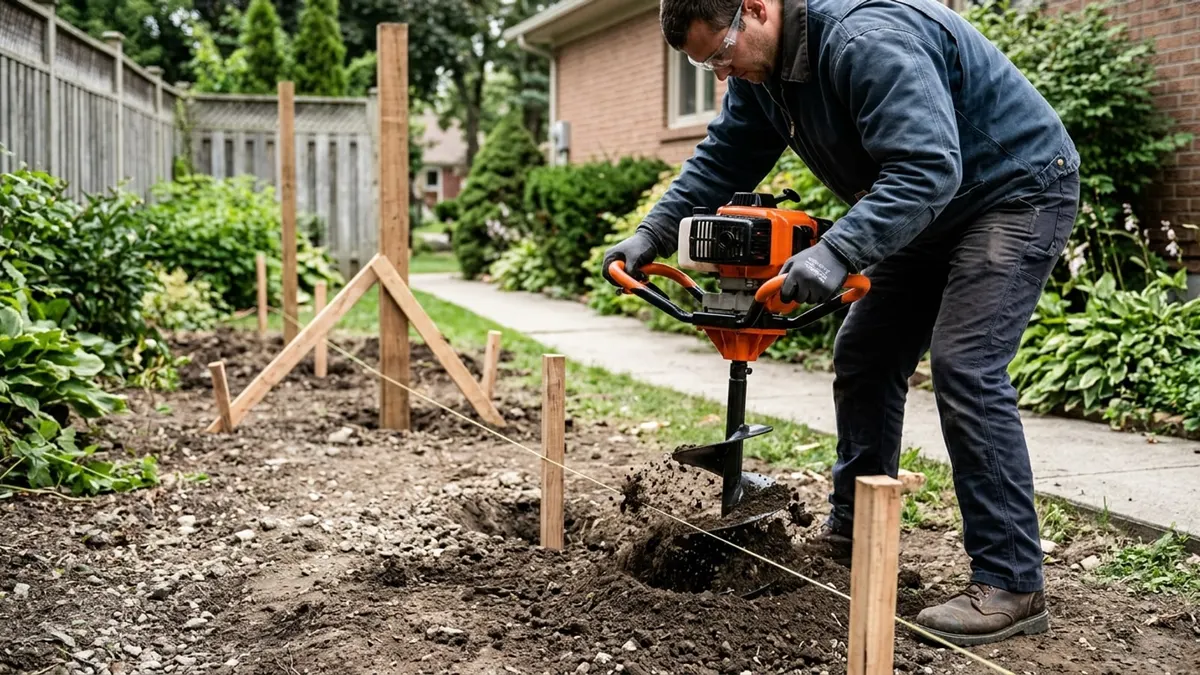
Cover image: Illustration: Construction Gear Review (AI-generated)
Related guides
Electric Post Hole Diggers: Corded Augers for Fences and Planting (2026)
No gas, no mix, no pull cord: four corded augers and the jobs they suit.
How Much Concrete per Fence Post: Bags by Hole Size and Depth
Bag counts for common post hole sizes, and why the post itself saves you a little concrete.
Manual Post Hole Diggers: Clamshell Diggers and Hand Augers (2026)
For a handful of posts, a good clamshell digger or hand auger beats renting a machine.