
Hand Tampers: Steel Tampers for Soil, Gravel and Post Holes (2026)
The best hand tampers for soil, gravel and post holes: 8 and 10 inch steel tampers compared on head size, handle, weight and welded or bolted build.
Affiliate disclosure: product links on this page go to Amazon or to the maker's own store. As an Amazon Associate we earn from qualifying purchases, at no extra cost to you; links to makers' own stores earn us nothing. No retailer or brand sees our picks before they are published or has any say in them. How we choose.
For small pads, walkways, trench backfill and post holes, the hand tamper to buy is the Estwing 62491: a 10 by 10 inch steel base fully welded to a 45 inch steel handle with a cushion grip and a powder-coated finish. An 8 inch head, like the BlumeTrec 8 x 8, concentrates your force and fits post holes and narrow trenches.
Our top picks at a glance
- Estwing 62491 10 x 10 in tamper
Head: 10 x 10 in steel, ribbed · Handle: 45 in steel, cushion grip · Build: Fully welded, powder coated · For: Soil, gravel, asphalt, clay
2. Best for post holes and trenches
BlumeTrec 8 x 8 in steel tamperHead: 8 x 8 in steel · Handle: 48 in steel · Build: Bolted with locking hardware · For: Post holes, narrow trenches
- BlumeTrec 10 x 10 in steel tamper
Head: 10 x 10 in steel · Handle: 48 in steel · Build: Bolted with locking hardware · For: Pads, walkways
- Moosefield 8 x 8 in welded tamper
Head: 8 x 8 in steel · Handle: 45 in steel, overmold grip · Build: Fully welded, powder coated · For: Soil, asphalt, post holes
| Pick | Head | Handle | Build | For | Buy |
|---|---|---|---|---|---|
| Estwing 62491 10 x 10 in tamperBest overall | 10 x 10 in steel, ribbed | 45 in steel, cushion grip | Fully welded, powder coated | Soil, gravel, asphalt, clay | Amazon |
| BlumeTrec 8 x 8 in steel tamperBest for post holes and trenches | 8 x 8 in steel | 48 in steel | Bolted with locking hardware | Post holes, narrow trenches | Amazon |
| BlumeTrec 10 x 10 in steel tamperBest budget 10 inch | 10 x 10 in steel | 48 in steel | Bolted with locking hardware | Pads, walkways | Amazon |
| Moosefield 8 x 8 in welded tamperBest welded 8 inch | 8 x 8 in steel | 45 in steel, overmold grip | Fully welded, powder coated | Soil, asphalt, post holes | Amazon |
Best overall
Estwing 62491 10 x 10 in tamper
A fully welded 10 x 10 inch tamper with a ribbed base and a cushion grip.
- Head
- 10 x 10 in steel, ribbed
- Handle
- 45 in steel, cushion grip
- Build
- Fully welded, powder coated
- For
- Soil, gravel, asphalt, clay
Pros
- One welded piece: nothing to loosen
- Reinforcing ribs
Cons
- Fixed handle length
Estwing lists a 10 by 10 inch steel base with reinforcing ribs, fully welded to a 45 inch steel handle with an ergonomic cushion grip, and a corrosion-resistant powder-coated finish, for flattening and smoothing soil, gravel, asphalt and clay.
Best for post holes and trenches
BlumeTrec 8 x 8 in steel tamper
A 4.6 lb 8 x 8 inch tamper with a 48 inch handle for tight spots.
- Head
- 8 x 8 in steel
- Handle
- 48 in steel
- Build
- Bolted with locking hardware
- For
- Post holes, narrow trenches
Pros
- Smaller head concentrates force
- Long handle reduces bending
Cons
- Light: more blows needed
BlumeTrec lists an 8 by 8 inch steel head, a 48 inch all-steel handle, a rust-resistant coating, locking hardware for assembly, and a weight of 4.6 lb.
Best budget 10 inch
BlumeTrec 10 x 10 in steel tamper
The 10 x 10 inch version of BlumeTrec's tamper, with the same 48 inch handle.
- Head
- 10 x 10 in steel
- Handle
- 48 in steel
- Build
- Bolted with locking hardware
- For
- Pads, walkways
Pros
- Wider head covers area faster
- Long handle
Cons
- Assembly required
BlumeTrec lists a 10 by 10 inch steel head, a 48 inch all-steel handle, a rust-resistant coating and included locking hardware.
Best welded 8 inch
Moosefield 8 x 8 in welded tamper
An 8 x 8 inch tamper welded in one piece, ready to use out of the box.
- Head
- 8 x 8 in steel
- Handle
- 45 in steel, overmold grip
- Build
- Fully welded, powder coated
- For
- Soil, asphalt, post holes
Pros
- No assembly, no loose parts
- Overmold grip
Cons
- Smaller base than a 10 x 10 in tamper
Moosefield lists a one-piece, fully welded 45 inch steel handle and 8 by 8 inch base with an overmold grip and a powder-coated finish, shipped assembled.
How we chose
We compared head size, handle length and grip, and whether the tool is welded or bolted, from the makers' listings.
Head size
- 8 inch: more force per blow; fits post holes and trenches.
- 10 inch: covers pads and walkways faster.
Welded or bolted
Fully welded tampers (Estwing, Moosefield) have nothing to work loose. Bolted ones ship smaller and can be tightened.
Hand tamper or plate compactor?
A hand tamper handles post holes, trench backfill and a landing or two. For a patio or driveway base, CMHA's paver method uses a plate compactor and compacts base in lifts of about 4 to 6 inches; see plate compactors for pavers and plate compactor picks. Quikrete says to tamp and compact the sub-base until firm before pouring a slab.
What the head size does
A 10 by 10 inch head covers 100 square inches and an 8 by 8 inch head 64. The same blow on the smaller head therefore presses about 56 percent harder on each square inch, and covers about a third less ground (our arithmetic). A 4 by 4 ft landing takes about 23 blows a pass with the 10 inch head and 36 with the 8 inch, before any overlap. Use the small head where depth of compaction matters and the big one to finish a surface.
Thin layers
The Concrete Masonry and Hardscapes Association has paver bases spread and compacted in 4 to 6 inch lifts with a 7,000 lbf reversible plate, and says thinner lifts are needed with compactors in the 5,000 lbf range. A hand tamper delivers a small fraction of either, so the same logic pushes the layers much thinner still: place fill a few inches at a time in a trench or around a post, tamp it until it stops moving, then add the next. Filling a hole to the top and tamping only the surface leaves loose soil underneath.
Damp, not wet
Moisture decides whether soil will compact at all. The association's field check is to squeeze a handful: soil at the right moisture has no visible water, holds together as a ball, and breaks into a few pieces when dropped from 6 to 12 inches. Dust-dry fill will not knit, and saturated soil just moves aside. Sprinkle dry fill and let wet ground drain before you tamp.
Where a hand tamper is the right tool
The association's guide says compaction needs special attention next to edge restraints, catch basins and utility structures, which are the places a plate compactor cannot reach. Those edges and corners are hand tamper work even on a job with a machine. So are post holes: Quikrete's fast-setting method ends by filling the last 3 to 4 inches of the hole with soil, which is a job for a tamper. So is the base of a slab form, where Quikrete says to tamp and compact the sub-base until firm.
Where it is not
A hand tamper is the wrong tool for the pavers themselves. The association calls for a plate compactor of at least 5,000 lbf to seat pavers into their bedding sand, and says the bedding sand is screeded and then left undisturbed, not tamped. For anything larger than a landing, see plate compactors.
Backfilling a trench
Trench backfill is where a hand tamper earns its keep, because a plate compactor does not fit in a narrow trench. Put the soil back in layers and tamp each one. Designing Buildings Wiki's note on bulk materials explains why the pile never seems to fit back in at first and then sinks later: loose and compacted volumes differ, and it warns that no universal compaction allowance should be assumed. That is why soil is often left over on the day, and why a trench can settle later if the layers were not tamped.
Around a drain pipe the fill is stone, not soil. The paver association's guide describes a 4 inch perforated pipe with at least 3 inches of open-graded stone around it, finished level with the compacted soil beside it. The stone goes in first; the soil over and beside it is what gets tamped.
Checking the surface
For a base that pavers or a slab will sit on, flat matters as much as firm. The association's tolerance for a finished base is no more than 3/8 inch of variation under a 10 foot straightedge. A straight 2x4 and a level do the same check on a small pad: slide the board across the tamped surface, fill the low spots, shave the high ones, and tamp again. Quikrete adds one step before concrete goes on: dampen the sub-grade, without leaving puddles.
Frozen ground
The association's guide says not to place base material that is frozen, or to place base over frozen ground. Frozen ground is hard without being compacted. If the ground is frozen, the tamping waits.
One more place to keep the tamper away from is the bedding layer under pavers. The association says bedding sand is screeded to a nominal 1 inch and then left alone, and that it should never be used to make up for an uneven base. Fix the low spots in the base with the tamper first, check with a straightedge, and only then screed the sand.
Frequently asked questions
What size hand tamper should I buy?
An 8 inch head for post holes and trenches, a 10 inch head for pads and walkways.
Can I use a hand tamper for a paver patio?
Only for very small areas. CMHA's paver method compacts the base in 4 to 6 inch lifts with a plate compactor.
Do I need to tamp before pouring concrete?
Yes. Quikrete says to tamp and compact the sub-base until firm before placing concrete.
What is a concrete grill tamper for?
Pushing coarse aggregate below the surface of freshly placed concrete to help finishing. It has an open grill head, usually about 48 inches wide, and it is not for soil.
How thick a layer can a hand tamper compact?
Thin ones. The paver industry compacts base in 4 to 6 inch lifts with a 7,000 lbf plate and says lighter machines need thinner lifts. A hand tamper has a fraction of that force, so tamp fill in thin layers, a few inches at most.
Sources
- PAV-TEC-002: Construction of Interlocking Concrete Pavements, Concrete Masonry and Hardscapes Association
- Concrete Mix No. 1101 data sheet, Quikrete
- Fast-Setting Concrete Mix No. 1004-60 data sheet, Quikrete
- Converting between weight and volume for bulk construction materials, Designing Buildings Wiki
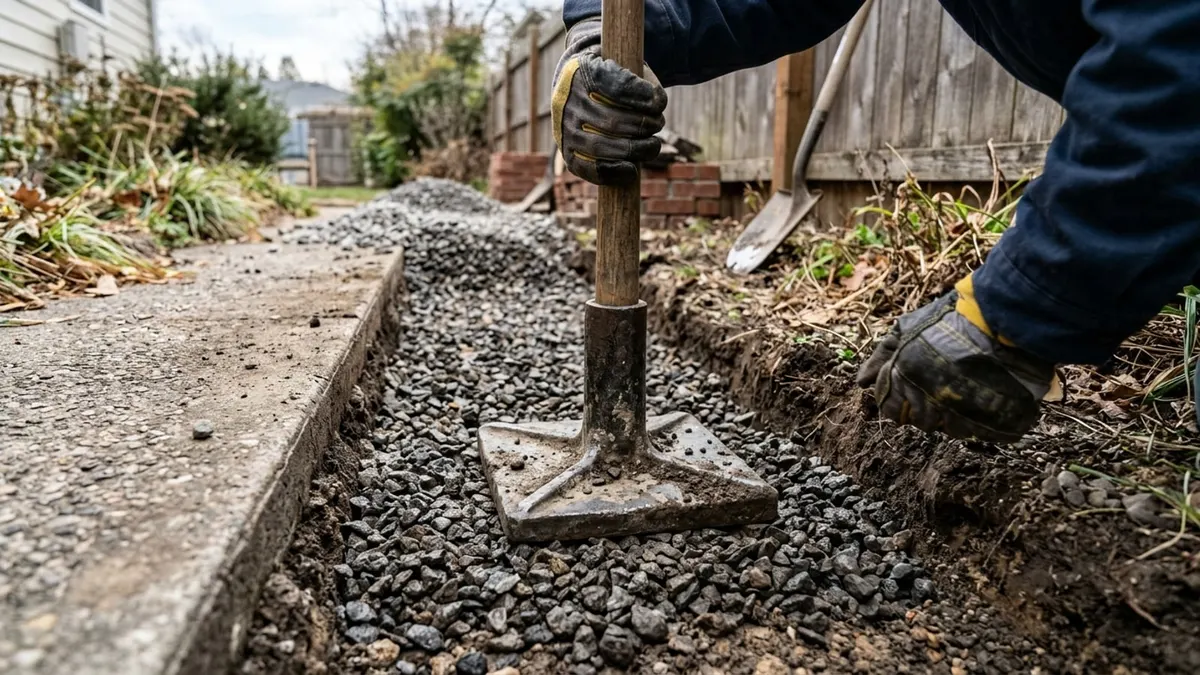
Cover image: Illustration: Construction Gear Review (AI-generated)
Related guides
Plate Compactors for Homeowners: Gas and Electric Plate Tampers (2026)
Five plate compactors, what their force numbers mean against paver specs, and when to rent a bigger one.
Using a Plate Compactor for Pavers: Base Depth, Lifts, Sand and Passes
The CMHA method in plain steps: 4 inch base for patios, 6 for driveways, compacted in lifts, then pavers and joint sand.
Manual Post Hole Diggers: Clamshell Diggers and Hand Augers (2026)
For a handful of posts, a good clamshell digger or hand auger beats renting a machine.