
Using a Plate Compactor for Pavers: Base Depth, Lifts, Sand and Passes
How to use a plate compactor for a paver patio: base thickness, 4 to 6 inch lifts, bedding sand, compacting pavers and joint sand, per CMHA.
Affiliate disclosure: product links on this page go to Amazon or to the maker's own store. As an Amazon Associate we earn from qualifying purchases, at no extra cost to you; links to makers' own stores earn us nothing. No retailer or brand sees our picks before they are published or has any say in them. How we choose.
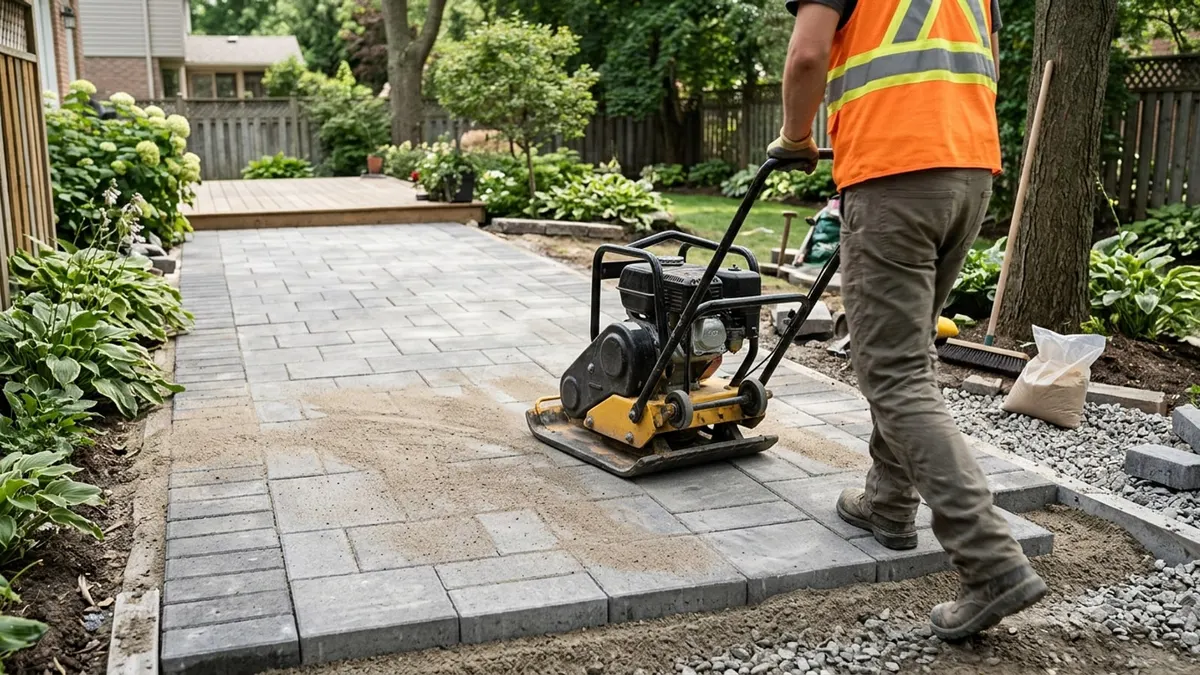
For a paver patio or walkway, the Concrete Masonry and Hardscapes Association (CMHA) calls for at least 4 inches of compacted base over well-drained soil (6 inches for a residential driveway), placed in lifts of about 4 to 6 inches and compacted one lift at a time. Then screed about 1 inch of bedding sand, lay the pavers, compact them with at least two passes, and compact dry joint sand in until the joints are full. A plate compactor does three of those jobs.
The steps (CMHA PAV-TEC-002)
- Call 811 a few business days before excavating; see 811 before you dig.
- Excavate and compact the soil beneath the base.
- Place base in lifts. CMHA says to spread and compact the base in lifts of 4 to 6 inches, kept consistent for even density. Compact each lift before adding the next.
- Reach the base thickness: at least 4 inches compacted for patios and walkways, at least 6 inches for residential driveways on well-drained soil. Heavier traffic and poor soils need more; heavy-duty pavements need an engineer.
- Screed bedding sand to a loose, uncompacted depth of about 1 inch, fill the screed rail grooves, and do not disturb it.
- Lay the pavers.
- Compact the pavers with at least two passes to seat them in the sand and push sand up into the joints. Compact within 6 feet of any unrestrained edge or the laying face, and finish compacting everything within 6 feet of the laying face at the end of each day.
- Joint sand: spread dry joint sand and compact until the joints are full, which CMHA says may take two or three passes.
What the steps leave out
The association's guide has details that decide whether a patio stays flat.
Slope. Set the grade before you dig. The guide gives a minimum slope of 1.5 percent, which is a fall of a little under 2 inches in 10 feet (our arithmetic), so water runs off and away from the house.
The soil. Remove roots, organic soil and large rocks from the dig and replace them with compacted aggregate. Compact the soil itself: the guide calls subgrade compaction critical and gives a moisture test, in which a handful squeezed into a ball breaks into a few pieces when dropped from 6 to 12 inches.
Fabric. A geotextile under the base is optional on good ground. The guide recommends it over clay and silty soils, where the soil stays wet for part of the year, and where the ground freezes and thaws. Turn it up the sides of the excavation and overlap sheets by at least 12 inches.
Edge restraints. They hold the pavers together and go in before the sand. At least 1 inch of the restraint's vertical face must bear against the side of the paver.
The sand. Bedding sand is concrete sand. The guide says masonry sand, limestone screenings and stone dust should never be used for bedding, because they often do not compact uniformly and can hold up drainage. It also says not to use the sand to level out a bad base: fix the base first.
Joints and cuts. Keep joints between 1/16 and 3/16 inch. Fill gaps over 3/8 inch at the edges with cut pavers, cut with a splitter or a masonry saw that controls dust. Draw pavers from three or four bundles at once so the color blends.
Rain. If rain threatens, cover the uncompacted edge so the bedding sand does not saturate. Do not place base that is frozen, or over frozen ground.
The compactor
CMHA's figure for paver compactors is at least 5,000 lbf of centrifugal force at 75 to 90 Hz, and it compacts base lifts with a 7,000 lbf reversible plate; machines around 5,000 lbf need thinner lifts. Homeowner compactors run lower: WEN's 56012 lists up to 4,496 lb and its 56096 up to 3,350 lb. With these, keep lifts toward the thin end, make extra passes, and consider renting a heavier reversible plate for a driveway. Picks are in plate compactors.
The association's figure has a second half, frequency: 75 to 90 hertz. Listings give blows per minute, which convert by dividing by 60 (our arithmetic). WEN's 56012 at 5,500 a minute is about 92 Hz and its 56096 at 5,700 is 95 Hz, both just above the top of the range. The guide also sets a tolerance for the finished job: the surface should not vary by more than 3/8 inch under a 10 foot straightedge, and the pavers can sit 1/8 to 1/4 inch above their final level to allow for a little settling, which it says is typical of all flexible pavements.
How much base
A 12 by 16 ft patio with 4 inches of compacted base needs 64 cubic feet, about 2.4 cubic yards, or roughly 3.7 tons of road base at 1.55 tons per yard (loose figures, so order a little extra). Run your own numbers in the gravel calculator.
How much sand
One inch of bedding sand over that 12 by 16 ft patio is 16 cubic feet, about 0.6 of a cubic yard, or roughly 0.8 tons of concrete sand at 1.35 tons per yard (our arithmetic from Designing Buildings Wiki's loose density). Joint sand is extra and finer; the guide says it should be dry when it is swept in.
Safety
Wear hearing protection and steel-toe boots, keep feet clear of the plate, and run gas engines outdoors.
Frequently asked questions
How thick should the base be under pavers?
CMHA calls for at least 4 inches of compacted base under patios and walkways on well-drained soil, and at least 6 inches under residential driveways.
How thick should each lift of base be?
CMHA says 4 to 6 inches, consistent from lift to lift, with thinner lifts for compactors in the 5,000 lbf range.
How much sand goes under pavers?
CMHA screeds bedding sand to a loose, uncompacted thickness of about 1 inch.
How many passes do you make over pavers?
At least two to seat the pavers, then two or three more with dry joint sand until the joints are full, per CMHA.
Do I need a plate compactor for a paver patio?
Yes for any real patio: CMHA's method compacts the base, the pavers and the joint sand with a plate compactor. A hand tamper only suits very small areas.
Sources
- PAV-TEC-002: Construction of Interlocking Concrete Pavements, Concrete Masonry and Hardscapes Association
- WEN 56096 6.5HP 196cc Plate Compactor, WEN Products
- Converting between weight and volume for bulk construction materials, Designing Buildings Wiki
Cover image: Illustration: Construction Gear Review (AI-generated)
Related guides
Hand Tampers: Steel Tampers for Soil, Gravel and Post Holes (2026)
For small pads, trench backfill and post holes, a good steel tamper does the job of a machine.
Plate Compactors for Homeowners: Gas and Electric Plate Tampers (2026)
Five plate compactors, what their force numbers mean against paver specs, and when to rent a bigger one.
Gravel Calculator: Cubic Yards and Tons of Gravel, Sand, Stone or Topsoil
Cubic yards and tons for driveways, paver bases and drainage, with the density behind every number.