
Trenchers for Homeowners: Walk-Behind, Handheld and Edger-Trenchers (2026)
The best trenchers for homeowners: a 24 inch walk-behind chain trencher, a handheld trencher, and electric edger-trenchers for shallow cable and irrigation runs.
Affiliate disclosure: product links on this page go to Amazon or to the maker's own store. As an Amazon Associate we earn from qualifying purchases, at no extra cost to you; links to makers' own stores earn us nothing. No retailer or brand sees our picks before they are published or has any say in them. How we choose.
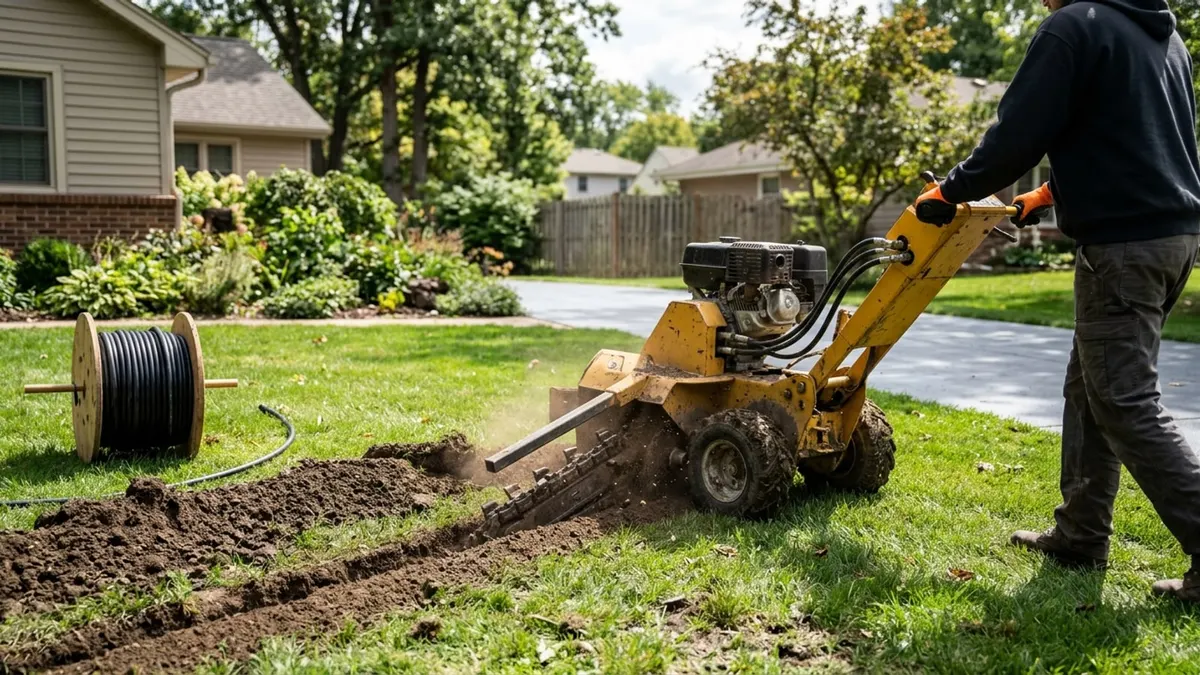
For water lines and electrical conduit up to 24 inches deep, the trencher to buy is the MechMaxx TCR1500: a 15 hp electric-start walk-behind chain trencher that cuts trenches up to 24 inches deep and 4 inches wide. For shallow irrigation and low-voltage wire, a handheld TrenchBadger Pro 12 cuts 12 inches deep and weighs 24 lb. For edging and very shallow cable runs, a 7.5 inch electric edger-trencher costs a fraction of either.
Call 811 before any of them touches the ground.
Our top picks at a glance
- MechMaxx TCR1500 24 in walk-behind trencher
Depth: Up to 24 in · Width: Up to 4 in · Power: 420cc 15 hp gas, electric start · Weight: Not stated
- TrenchBadger Pro 12 handheld trencher
Depth: 12 in · Width: 2.5 in (dual blade); 0.75 to 1 in (single) · Power: 2 hp gas · Weight: 24 lb
3. Best electric edger-trencher
WORX WG896 electric edger and trencherDepth: 1, 1-1/4 or 1-1/2 in · Width: Blade kerf · Power: 12 A corded · Weight: Not stated
- BLACK+DECKER LE760FF edger and trencher
Depth: 3 depth settings · Width: 3/16 in blade · Power: 12 A corded · Weight: Not stated
| Pick | Depth | Width | Power | Weight | Buy |
|---|---|---|---|---|---|
| MechMaxx TCR1500 24 in walk-behind trencherBest walk-behind trencher | Up to 24 in | Up to 4 in | 420cc 15 hp gas, electric start | Not stated | Amazon |
| TrenchBadger Pro 12 handheld trencherBest handheld trencher | 12 in | 2.5 in (dual blade); 0.75 to 1 in (single) | 2 hp gas | 24 lb | Amazon |
| WORX WG896 electric edger and trencherBest electric edger-trencher | 1, 1-1/4 or 1-1/2 in | Blade kerf | 12 A corded | Not stated | Amazon |
| BLACK+DECKER LE760FF edger and trencherAlso good: edger-trencher | 3 depth settings | 3/16 in blade | 12 A corded | Not stated | Amazon |
Best walk-behind trencher
MechMaxx TCR1500 24 in walk-behind trencher
A 420cc chain trencher for 24 inch deep trenches in loose, uniform soil.
- Depth
- Up to 24 in
- Width
- Up to 4 in
- Power
- 420cc 15 hp gas, electric start
- Weight
- Not stated
Pros
- 27 carbide teeth, Kevlar belt
- Depth control and anti-forward lock
- 1-year engine and machine warranty
Cons
- Maker warns against gravelly soil
- Heavy: plan how to move it
MechMaxx lists a 420cc 15 hp OHV engine with a 12 V battery for electric start, 27 carbide teeth and 9 scrapers on an 81.5 inch chain, a Kevlar drive belt, a depth control handle and an anti-forward lock, for trenches up to 24 inches deep and 4 inches wide. It warns the machine suits relatively uniform, loose sandy soil and not soil with a lot of gravel. Warranty: 1 year on the engine and 1 year on the machine.
Best handheld trencher
TrenchBadger Pro 12 handheld trencher
A 24 lb gas trencher for 12 inch irrigation, wiring and silt fence trenches.
- Depth
- 12 in
- Width
- 2.5 in (dual blade); 0.75 to 1 in (single)
- Power
- 2 hp gas
- Weight
- 24 lb
Pros
- Fits in a truck bed, no trailer
- Blade options for roots or compact soil
Cons
- Shallow: not for frost-depth water lines
TrenchBadger lists a 2 hp gas unit starting at 24 lb, cutting 12 inches deep, 2.5 inches wide with dual blades or 0.75 to 1 inch with a single blade, for irrigation, low-voltage wiring, fiber and silt fencing, with standard or BadgerClaw blades for compact soils.
Best electric edger-trencher
WORX WG896 electric edger and trencher
A corded 12 amp edger that cuts shallow trenches for wire and edging.
- Depth
- 1, 1-1/4 or 1-1/2 in
- Width
- Blade kerf
- Power
- 12 A corded
- Weight
- Not stated
Pros
- 3-year limited warranty
- Adjustable shaft
Cons
- 1.5 inch maximum depth
- Needs an extension cord
WORX lists a 12 amp motor spinning a 7.5 inch blade at 4,700 rpm, three depths (1, 1-1/4 and 1-1/2 inches), a cutting line indicator and an adjustable shaft, with a 3-year limited warranty. It suits lawn edging and burying low-voltage landscape lighting wire where shallow burial is allowed.
Also good: edger-trencher
BLACK+DECKER LE760FF edger and trencher
BLACK+DECKER's 2-in-1 corded edger and shallow trencher.
- Depth
- 3 depth settings
- Width
- 3/16 in blade
- Power
- 12 A corded
- Weight
- Not stated
Pros
- Converts between edging and trenching
- 2-year limited warranty
Cons
- Depths not listed in inches
The listing gives a 12 amp motor, a 7.5 inch blade 3/16 inch thick, three blade depth positions, a pull-up edge guide and quick conversion between edging and trenching modes, with a 2-year limited warranty.
How we chose
We matched trenchers to trench depth and width, then checked power, soil limits and warranty on the listings.
Which type
| Job | Trencher |
|---|---|
| Water lines, conduit, drainage (to 24 in) | Walk-behind chain trencher |
| Irrigation, low-voltage wire (to 12 in) | Handheld trencher |
| Edging, very shallow wire | Edger-trencher |
| Deeper or longer runs, rocky soil | Rent a ride-on or mini excavator |
Soil matters
Chain trenchers bog down and wear quickly in gravel; MechMaxx warns against gravelly soil. For rocky ground, a mini excavator with a narrow trenching bucket may be the better tool.
How much soil a trench makes
A trencher's narrow cut is its whole point. By our arithmetic, 100 feet of the MechMaxx's widest and deepest trench, 4 inches by 24, is about 2.5 cubic yards of soil. The same length cut 12 inches deep and 2.5 inches wide with the TrenchBadger is about 0.8 of a cubic yard. Dug 12 inches wide with a shovel or a bucket, a 24 inch deep trench of that length is 7.4 cubic yards, three times the work to dig and three times to put back. At Designing Buildings Wiki's indicative 1.25 short tons per cubic yard for loose subsoil, that is the difference between about 3 tons and about 9.
Depth is set by what you are burying
Pick the trencher after you know the depth, not before. How deep a water line, a gas line, an electrical conduit or a low-voltage cable has to go is set by your local code and, for water, by your frost depth. Call the building department with the list of what you are burying and write down the depth for each. An edger-trencher that cuts 1-1/2 inches is for landscape lighting cable where shallow burial is allowed and for nothing else on that list.
Crossing a marked line
A trencher will go through a buried cable without slowing down. 811's marks show approximately where utility lines run, and OSHA's excavation rule for workplaces says the exact location must be found by safe and acceptable means before digging continues near one. In practice that means stopping the trencher short of each mark, exposing the line by hand, and hand-digging the crossing. Private lines such as a feed to a shed or an irrigation main are usually yours to locate, so trace those before you start.
Soil, roots and rock
MechMaxx says plainly that its chain trencher is for fairly uniform, loose, sandy soil and not for ground with a lot of gravel. TrenchBadger sells a second blade type for compact soils. Neither is a rock tool. If a test hole with a shovel turns up cobbles or heavy roots along the route, a trencher will stall and wear teeth, and a mini excavator with a narrow bucket is the better machine for the day.
Renting the walk-behind
A 24 inch walk-behind trencher is used for a day and then stored for years. If the job is one water line, price a day's rental first; buying makes sense for a property with repeated runs of irrigation or conduit to lay. A handheld trencher is small enough that storage is not the question.
What a trencher cannot do
A chain trencher cuts a slot, and some jobs need more than a slot. The paver industry's guide describes a perimeter drain as a 4 inch perforated pipe with at least 3 inches of open-graded stone around it, which is 10 inches across at the least (our arithmetic). The widest trench on this page is 4 inches. A drain of that kind is a job for a bucket: see mini excavator attachments.
What 811 will ask
Have the address, the county and nearest cross street, the type of project and the exact route of the trench ready when you contact 811, a few business days before you start. Then wait until every utility has responded. A trench crosses more of a property than any other job on this site, so it is the one most likely to cross a line.
OSHA's fact sheet adds two habits worth copying on any trench: inspect it again after rain or anything else that could have changed it, and keep heavy equipment back from the edge.
Safety first
- 811: contact the free before-you-dig service a few business days ahead, wait until all utilities have responded, and dig carefully around the marks. See 811 before you dig.
- Depth rules: check local code for how deep each kind of line must be buried.
- Trenches: OSHA requires protective systems for trenches 5 feet deep or more; keep spoil piles at least 2 feet from the edge.
Frequently asked questions
What is the best trencher for a homeowner?
For water lines and conduit to 24 inches, a walk-behind chain trencher like the MechMaxx TCR1500. For shallow irrigation, a handheld trencher like the TrenchBadger Pro 12 at 24 lb.
How deep can a handheld trencher dig?
The TrenchBadger Pro 12 cuts 12 inches deep, enough for irrigation and low-voltage wire.
Can a trencher dig through rocky soil?
Chain trenchers struggle in gravel; MechMaxx warns its TCR1500 is for loose, uniform soil. Rocky ground often calls for a mini excavator.
Do I need to call 811 before trenching?
Yes. Contact 811 a few business days before digging so utilities can mark buried lines, and wait for all to respond.
How deep should I trench for a water line or cable?
Local code sets the depth for each kind of line, and frost depth sets it for water. Ask your building department before choosing a trencher: the machines here cut from 1-1/2 inches to 24 inches deep.
Sources
- 811 Before You Dig, Common Ground Alliance
- Trenching and Excavation Safety fact sheet, OSHA
- 29 CFR 1926.651, Specific excavation requirements, OSHA
- Converting between weight and volume for bulk construction materials, Designing Buildings Wiki
- PAV-TEC-002: Construction of Interlocking Concrete Pavements, Concrete Masonry and Hardscapes Association
Cover image: Illustration: Construction Gear Review (AI-generated)
Related guides
Buying an Imported Mini Excavator Online: What to Check Before You Order
Engine, emissions, warranty, parts, freight and fit: the checks that separate a good import from an expensive yard ornament.
Mini Excavator Attachments: Buckets, Thumbs, Tilt Buckets and How to Check Fit
Which attachments earn their keep on a small machine, and the three measurements to take first.
Mini Excavators for Property Owners: The 1 to 2 Ton Machines Sold Online (2026)
Five small excavators sold online, what each listing actually commits to, and what to check before you order one.