
One-Man vs Two-Man Auger: Which Earth Auger for Your Holes?
One-man vs two-man auger: bit sizes, engine sizes, control and kickback, with real powerheads from Earthquake, THUNDERBAY and Garden Trax compared.
Affiliate disclosure: product links on this page go to Amazon or to the maker's own store. As an Amazon Associate we earn from qualifying purchases, at no extra cost to you; links to makers' own stores earn us nothing. No retailer or brand sees our picks before they are published or has any say in them. How we choose.
Use a one-man auger for 6 to 8 inch holes in ordinary soil; use a two-man auger for 10 inch and larger bits, hard ground, or many deep holes. A two-man powerhead spreads the twisting force of a bit that catches across two operators, which matters most with big bits. Dual-use powerheads like the Earthquake Dually and THUNDERBAY Partner Up have throttles for either.
Side by side
| One-man | Two-man | |
|---|---|---|
| Typical bits | 4 to 8 in | 8 to 12 in and up |
| Example | Earthquake E43: 43cc, 8 in bit | Garden Trax: 185cc 4-cycle, holes up to 14 in |
| Control when a bit catches | One person absorbs the twist | Two people share it |
| Weight | Lighter | Heavier |
| Crew | Solo | Needs a helper |
The powerheads
- Earthquake E43: one-person, 43cc, 30:1 transmission, 8 by 36 inch bit, 5-year limited warranty.
- Earthquake Dually 10310: one or two-person, 52cc, two throttles, centrifugal clutch that slips on impact, fits 2 to 10 inch bits (none included).
- THUNDERBAY Partner Up: one or two-person, 52cc, 8 inch bit and 12 inch extension, two throttles, fits THUNDERBAY 2 to 10 inch bits.
- Garden Trax 185cc: two-person, 4-cycle 185cc (3.4 hp), 7/8 inch output shaft, holes up to 14 inches.
Start from the hole, not the machine
The post decides the hole and the hole decides the auger. Quikrete's rule for a post set in concrete is a hole about three times the post's diameter and a third of the post's length deep. A steel post 2 inches across needs a 6 inch hole. A 4x4, at 3.5 inches, needs about 10. A 6x6, at 5.5 inches, needs more than 16, which is past the 14 inch limit Garden Trax gives for its two-man powerhead, so those holes get a 12 inch bit and hand work, or a machine.
By that measure a one-man auger with an 8 inch bit covers steel posts and is a little tight for 4x4s, and the 10 and 12 inch bits that fit 4x4s properly are where the second pair of hands starts to matter.
Engines: mixed fuel or straight gas
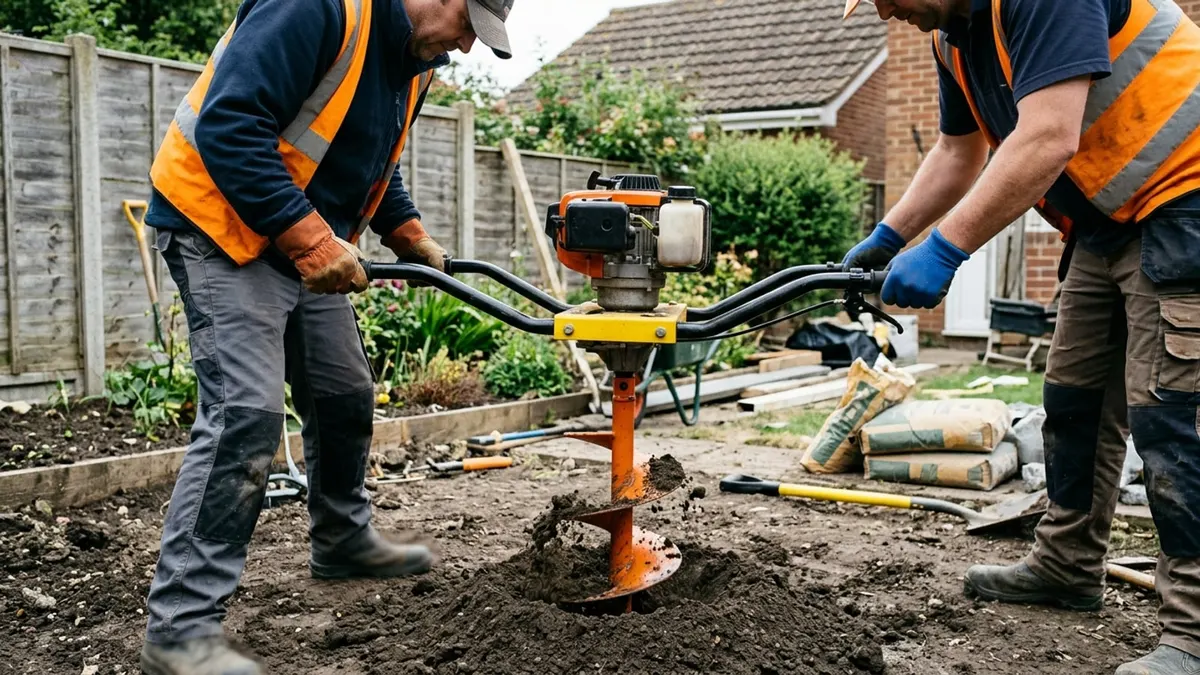
One-man and dual-use powerheads are two-stroke: the E43 is 43cc, and the Dually and THUNDERBAY Partner Up 52cc. They run on gas mixed with oil at the ratio in the manual. The big two-man machines are four-cycle. Garden Trax lists a 185cc, 3.4 hp four-cycle engine, and Ardisam's Earthquake range includes two-man powerheads with Briggs and Stratton, Honda and Kohler four-cycle engines. Four-cycle engines take straight gasoline. These are the larger, heavier powerheads, built with two sets of handles.
How many holes
A helper is easy to find for a deck's dozen footings and harder for a fence that takes three weekends. A 100 ft fence at 8 ft spacing is 14 holes; a 300 ft boundary is 39 (our arithmetic). If you will mostly work alone, a dual-use powerhead that one person can run with a small bit and two can run with a large one covers both days.
What comes out and what goes in
A 10 inch hole 30 inches deep is about 1.36 cubic feet. It brings up that much soil and takes three 80 lb bags of concrete at Quikrete's yields. A 12 inch hole 36 inches deep is about 2.36 cubic feet and four bags. For 14 posts, the larger hole means 14 more bags and about half a cubic yard more soil (our arithmetic). Bigger bits cost effort twice: once drilling and once filling.
Kickback and safety
When a spinning bit hits a root or rock, the handles try to rotate the other way. Earthquake's Dually uses a centrifugal clutch that slips on sudden impact to reduce that. Keep a wide stance, let the bit do the work, lift it often to clear soil, and never brace the handles against your body. Call 811 a few business days before digging.
Buried lines
Contact 811 a few business days before drilling and wait for every utility to respond. The marks show approximate positions. OSHA's excavation rule for workplaces says the exact location of a line must be found by safe and acceptable means when digging gets near it, and a powered auger of either kind is not that. Dig the holes beside a mark by hand, or move the post.
Depth and extensions
Quikrete puts a third of the post in the ground, so a 6 ft fence on 9 ft posts needs 3 ft holes. The E43's bit is 36 inches long and reaches that as it comes. THUNDERBAY's Partner Up comes with an 8 inch bit and a 12 inch extension. Bits for the big two-man powerheads are bought separately, so check their length when you choose them, and lift the bit often to clear soil in a deep hole.
California
California regulates spark-ignition engines of 19 kilowatts or less as small off-road engines, which takes in every powerhead on this page, two-stroke or four-cycle. Some are not certified for sale there and their listings say so. Check for a CARB statement before you compare engines.
Concrete on the same day
Drilling is fast enough that the concrete becomes the slow part. Three 80 lb bags fill a 10 inch hole 30 inches deep, and four fill a 12 inch hole 36 inches deep, at Quikrete's yields. Its Fast-Setting mix goes in dry around the post and is watered in the hole, which saves a mixer on a fence line and lets one person set posts while the other drills.
Before either machine starts, 811 will want the address, the county and nearest cross street, the type of project and where on the property the holes will go. For a fence that means walking the line and counting posts first, which is also how you find out whether the job is 14 holes or 40, and so which machine it calls for.
Which to buy
- Fence line in good soil, solo: a one-man auger; see gas post hole diggers.
- Deck footings, 10 to 12 inch holes: a two-man or dual-use powerhead with a helper.
- Both: a dual-use powerhead.
Frequently asked questions
What is the difference between a one-man and two-man auger?
A two-man auger has handlebars and throttles for two operators, so the twisting force of a bit that catches is shared. One-man augers are lighter and suit smaller bits.
What size hole needs a two-man auger?
Bits of 10 inches and larger, or hard ground, are where a second operator helps. Garden Trax's two-man powerhead drills holes up to 14 inches.
Can one person run a two-man auger?
Dual-use powerheads like the Earthquake Dually and THUNDERBAY Partner Up have throttle positions for one or two operators. Use two people with large bits.
Are auger bits interchangeable?
Many share a 7/8 inch output shaft, but check the powerhead's shaft and the bit's fitting. Garden Trax lists compatibility with bits for a 7/8 inch shaft.
What size auger bit do I need for a 4x4 post?
About 10 inches, by Quikrete's rule of a hole three times the post's diameter: a 4x4 measures 3.5 inches. An 8 inch bit is a tighter fit, and a 6 inch bit suits steel posts about 2 inches across.
Sources
- Earth Auger Powerheads, Ardisam (Earthquake)
- 811 Before You Dig, Common Ground Alliance
- Concrete Mix No. 1101 data sheet, Quikrete
- 29 CFR 1926.651, Specific excavation requirements, OSHA
- Small Off-Road Engines (SORE), California Air Resources Board
- Fast-Setting Concrete Mix No. 1004-60 data sheet, Quikrete
Cover image: Illustration: Construction Gear Review (AI-generated)
Related guides
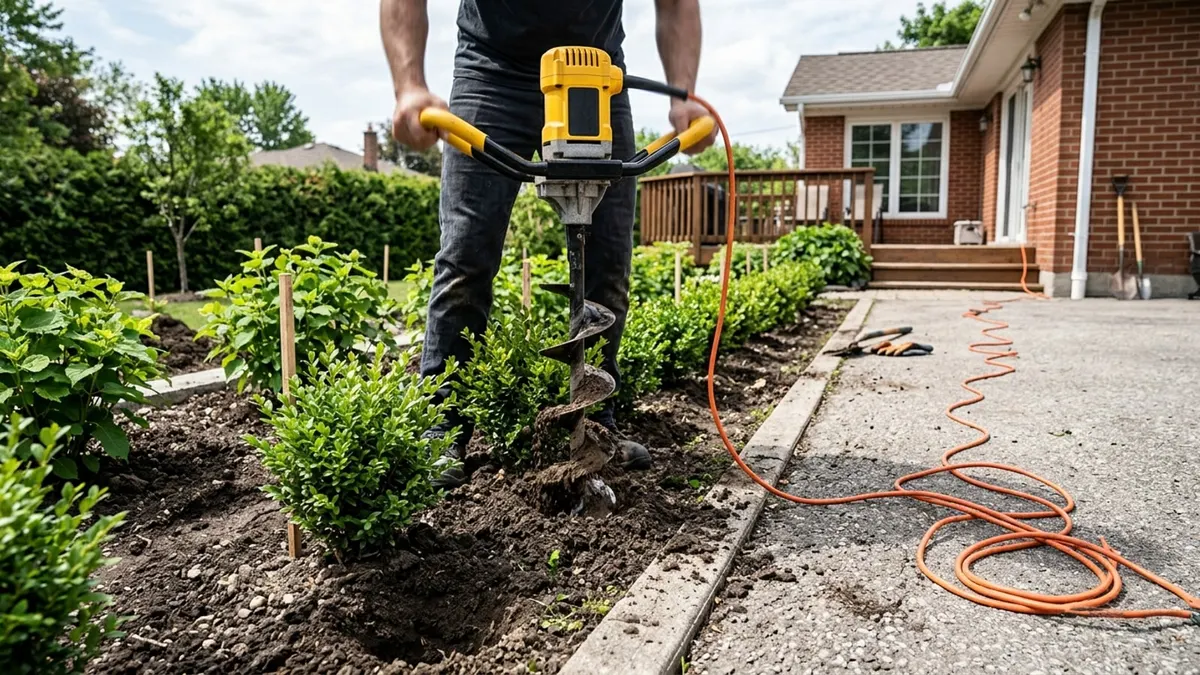
Electric Post Hole Diggers: Corded Augers for Fences and Planting (2026)
No gas, no mix, no pull cord: four corded augers and the jobs they suit.
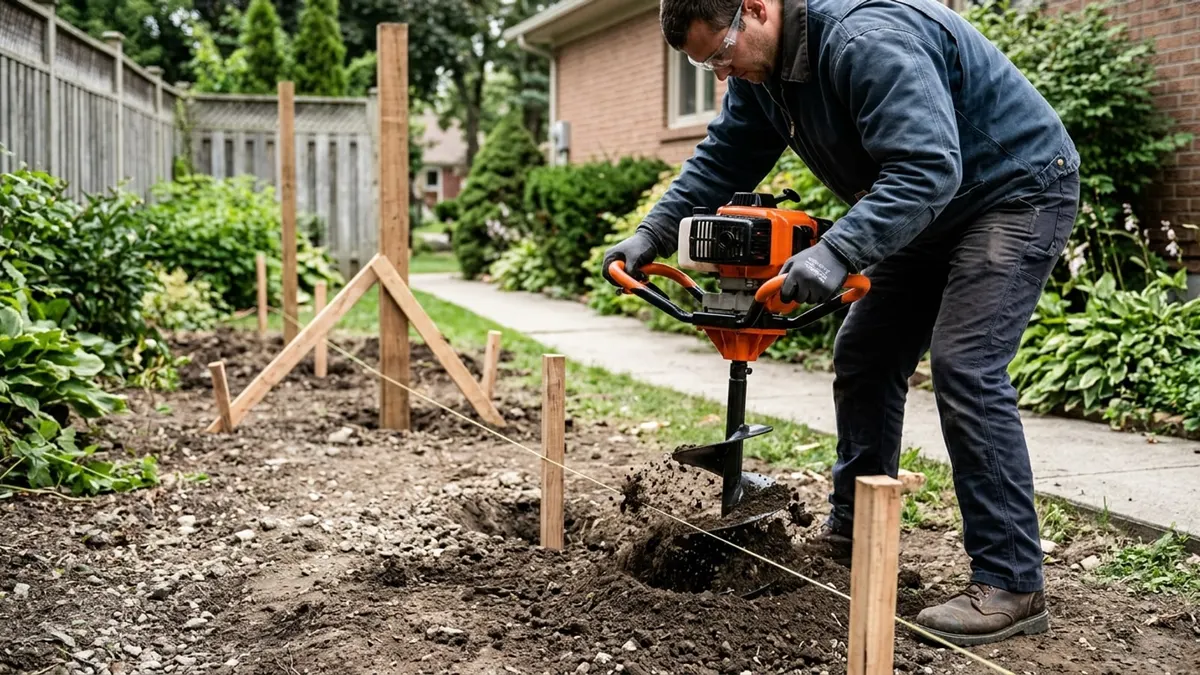
Gas Post Hole Diggers: The Best Earth Augers for Fences and Decks (2026)
Five gas augers from a 43cc one-person powerhead to a 72cc digger, plus which bits come in the box.
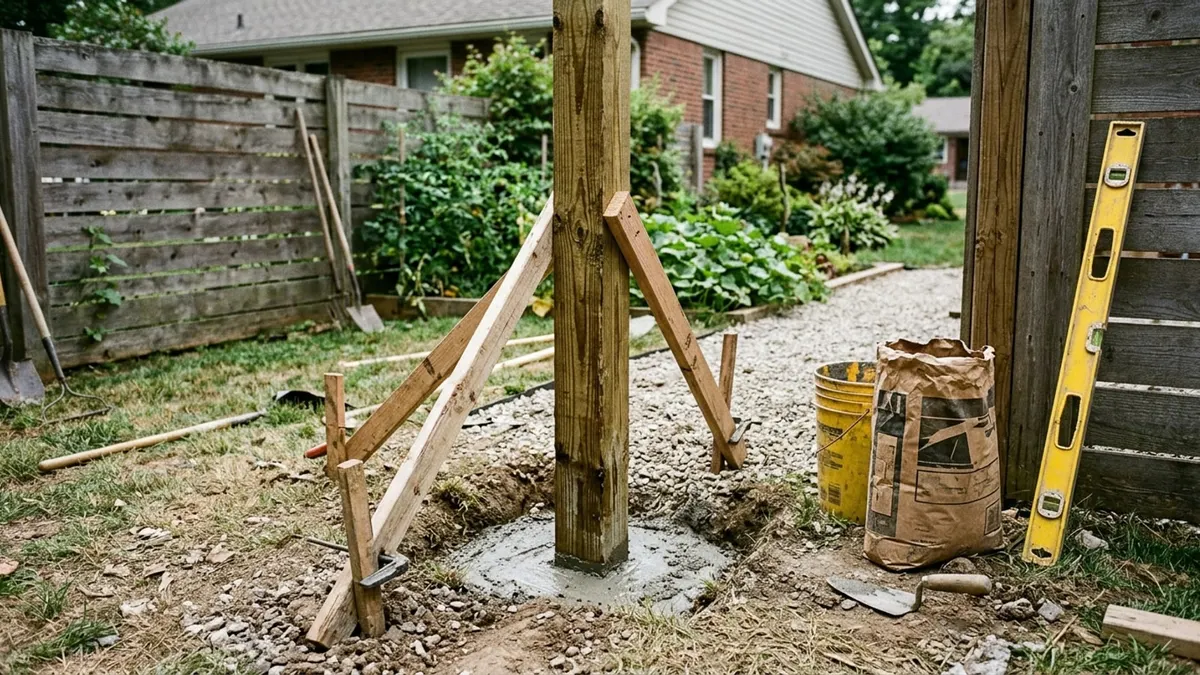
How Much Concrete per Fence Post: Bags by Hole Size and Depth
Bag counts for common post hole sizes, and why the post itself saves you a little concrete.