
Electric Jackhammers for Breaking Concrete: Breaker Hammers Compared (2026)
The best electric jackhammers for breaking slabs: Bosch and Makita breaker hammers and budget 2,200 W models, with impact energy claims explained.
Affiliate disclosure: product links on this page go to Amazon or to the maker's own store. As an Amazon Associate we earn from qualifying purchases, at no extra cost to you; links to makers' own stores earn us nothing. No retailer or brand sees our picks before they are published or has any say in them. How we choose.
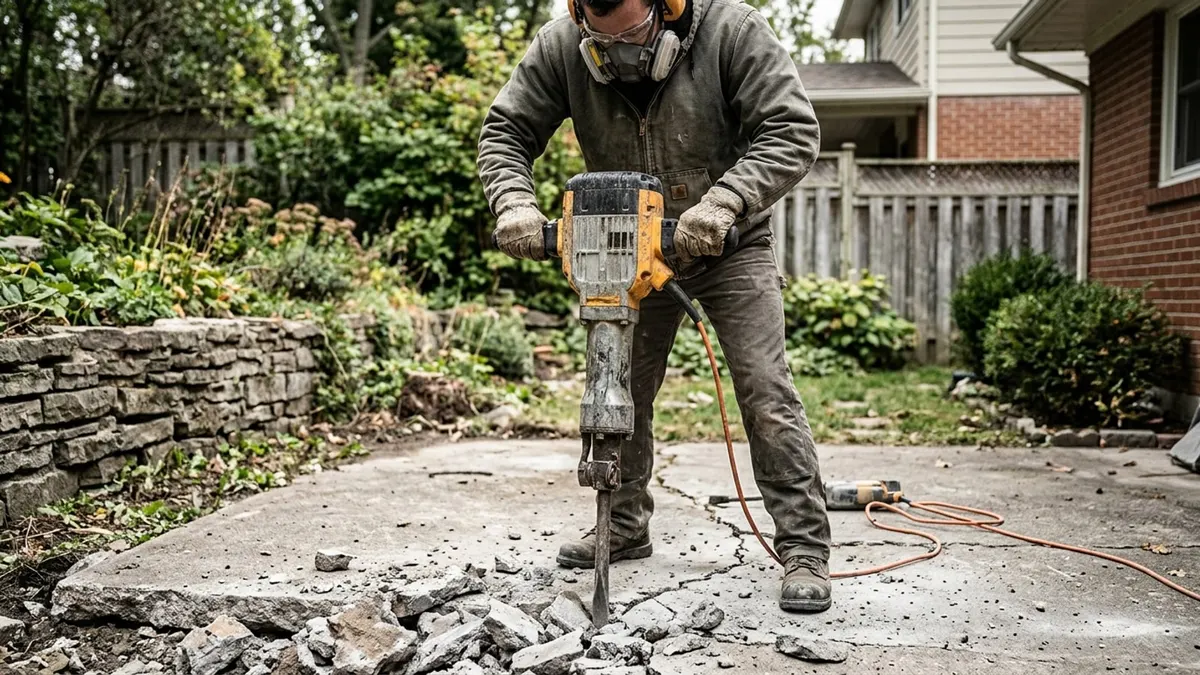
For breaking out a slab, steps or footings, the jackhammer to buy is the Makita HM1810X3: a 70 lb class breaker Makita rates at 46.5 ft-lb of impact energy from a 15 amp motor, with an internal counterbalance against vibration. Bosch's BH2760VCB is the alternative at 35 ft-lb and 63 lb with a cart. For a one-time patio, a budget 2,200 W hammer like the VEVOR 2200 W costs a fraction and does the job more slowly.
Our top picks at a glance
- Makita HM1810X3 70 lb breaker hammer
Impact energy: 46.5 ft-lb · Motor: 15 A · Bits: 1-1/8 in hex
- Bosch BH2760VCB Brute breaker hammer with basic cart
Impact energy: 35 ft-lb · Motor: 120 V · Bits: 1-1/8 in hex
- VEVOR 2200 W electric jackhammer
Impact energy: 66 J claimed, 1,350 bpm · Motor: 2,200 W, 110 V · Bits: 6 chisels included
- XtremepowerUS 2200 W electric jackhammer
Impact energy: Up to 35 J claimed · Motor: 2,200 W · Bits: 1-1/8 in hex flat and point
| Pick | Impact energy | Motor | Bits | Buy |
|---|---|---|---|---|
| Makita HM1810X3 70 lb breaker hammerBest overall | 46.5 ft-lb | 15 A | 1-1/8 in hex | Amazon |
| Bosch BH2760VCB Brute breaker hammer with basic cartBest vibration control | 35 ft-lb | 120 V | 1-1/8 in hex | Amazon |
| VEVOR 2200 W electric jackhammerBest budget | 66 J claimed, 1,350 bpm | 2,200 W, 110 V | 6 chisels included | Amazon |
| XtremepowerUS 2200 W electric jackhammerAlso good: budget | Up to 35 J claimed | 2,200 W | 1-1/8 in hex flat and point | Amazon |
Best overall
Makita HM1810X3 70 lb breaker hammer
A 70 lb class breaker rated at 46.5 ft-lb with anti-vibration technology.
- Impact energy
- 46.5 ft-lb
- Motor
- 15 A
- Bits
- 1-1/8 in hex
Pros
- Internal counterbalance reduces vibration
- Automatic brush cut-off
- LED power light flags cord damage
Cons
- Heaviest here
- Pro price
Makita lists a 15 amp motor delivering 46.5 ft-lb of impact energy, Anti-Vibration Technology with an internal counterbalance, fixed handles, an automatic brush cut-off and an LED power light that indicates switch failure or cord damage.
Best vibration control
Bosch BH2760VCB Brute breaker hammer with basic cart
A 63 lb Bosch breaker with Active Vibration Control and a basic cart.
- Impact energy
- 35 ft-lb
- Motor
- 120 V
- Bits
- 1-1/8 in hex
Pros
- Active Vibration Control and shock-absorbing handles
- Service Minder brush system
- Basic cart, moil point and flat chisel included
Cons
- Less impact energy than the Makita or Bosch's own BH2770VCD
- Heavy
Bosch lists the BH2760VCB at 35 ft-lb of impact energy for a tool weighing 63 lb, with Active Vibration Control, shock-absorbing handles, a grease-packed gearbox and hammer mechanism, and a Service Minder system that shuts the hammer off when brushes or lubrication need attention. The kit includes a basic cart, one moil point chisel and one flat chisel (per the Amazon listing).
Bosch's stronger model is the BH2770VCD Brute Turbo, which its product page rates at 43 ft-lb (EPTA) and 1,000 blows per minute with a deluxe cart, on a 15 amp, 120 V outlet or a 2,500 W portable generator.
Best budget
VEVOR 2200 W electric jackhammer
A 2,200 W hammer with six chisels and a case, for occasional slab removal.
- Impact energy
- 66 J claimed, 1,350 bpm
- Motor
- 2,200 W, 110 V
- Bits
- 6 chisels included
Pros
- Six chisels including clay spade
- 360 degree side handle
Cons
- Impact claim not tied to a test method
- Shorter life under daily use
VEVOR lists a 2,200 W motor with 66 J of impact energy at 1,350 blows per minute, a 360 degree rotating handle, a cooling system, and six chisel bits including pointed, flat and clay spade chisels, with a case.
Also good: budget
XtremepowerUS 2200 W electric jackhammer
A 2,200 W hammer with point and flat chisels and a 360 degree auxiliary handle.
- Impact energy
- Up to 35 J claimed
- Motor
- 2,200 W
- Bits
- 1-1/8 in hex flat and point
Pros
- Standard 1-1/8 in hex chisels
- Cooling vents
Cons
- Impact energy is a claim with no test method stated
XtremepowerUS lists a 2,200 W motor with up to 35 J of impact energy, a 360 degree adjustable auxiliary handle, a ventilation cooling system and 1-1/8 inch hex flat and point chisels. Its 2,800 W model's title claims 55 J while its bullets say up to 35 J, an example of why budget figures need caution.
How we chose
We compared impact energy, motor and bit system from the makers' listings and Bosch's product page.
Reading impact energy claims
Bosch states its 43 ft-lb (about 58 J) figure to the EPTA test procedure. Budget listings give figures in joules without a method, and some exceed Bosch's at a fraction of the weight: VEVOR claims 66 J, while XtremepowerUS's 2,800 W listing says 55 J in its title and 35 J in its bullets. Treat unmeasured claims as marketing; tool weight and a pro maker's rating are better guides to breaking power.
Jackhammer or demolition hammer?
Breaker hammers (60 to 70 lb class) break slabs from above, letting their weight do the work. Lighter demolition hammers (12 to 35 lb) chip, remove tile and work on walls. See jackhammer vs demolition hammer and demolition hammer picks.
Silica and safety
OSHA lists jackhammers among the common sources of silica dust, which causes silicosis and lung cancer. Use water to keep dust down, wear a respirator, and protect your eyes, ears, hands and feet. See silica dust safety. Before breaking a slab, check for buried lines and in-slab pipes or wiring, and call 811 before digging beneath it.
The same numbers in one unit
Pro makers quote foot-pounds and budget listings quote joules, which hides how odd some claims are. One foot-pound is about 1.36 joules. By our arithmetic, Makita's 46.5 ft-lb is about 63 J, Bosch's 43 ft-lb for the BH2770VCD about 58 J, and the BH2760VCB's 35 ft-lb about 47 J. VEVOR's 66 J would be about 49 ft-lb, more than either 60 to 70 lb pro breaker. XtremepowerUS's 35 J is about 26 ft-lb, and the 55 J in its other listing's title about 41 ft-lb.
OSHA's dust controls for jackhammers
OSHA's silica standard for construction has one row for both tools: jackhammers and handheld powered chipping tools. It offers two controls. One is a water delivery system that puts a continuous stream or spray of water on the point of impact. The other is a commercially available shroud with a dust collector that pulls the airflow the tool maker recommends and has a filter at least 99 percent efficient with a filter-cleaning mechanism.
With either control in use outdoors, the table asks for no respirator for up to four hours in a day, and a respirator with an assigned protection factor of 10 beyond four hours. Indoors or in an enclosed area, a basement floor for example, it asks for the respirator from the first minute, and the standard adds exhaust as needed so that visible dust does not build up. Water has to arrive at a rate that keeps visible dust down. None of the listings here mentions a water feed or a shroud, so that part of the job is yours to arrange.
Check the circuit
Bosch says the BH2770VCD needs no compressor and runs on any 115 or 120 V, 15 amp outlet or a 2,500 W portable generator. Makita lists 15 amps for the HM1810X3. The budget hammers are listed by wattage: 2,200 W at 110 to 120 V works out to between 18 and 20 amps (our arithmetic), which is more than a 15 amp household circuit is rated to supply. Read the amperage on the listing or the nameplate, and run a 2,200 W hammer from a circuit that can carry it.
Weight is the feature, and the problem
A breaker works because it is heavy: Bosch's two models weigh about 63 lb and Makita's is a 70 lb class tool. That weight has to get to the slab, up steps and back into the truck. Both Bosch kits include a cart, which is worth more than it sounds after the second hour.
Before you break anything
Find out what is in and under the slab. OSHA's excavation rule starts with locating underground installations before work begins, and 811 will have utility lines marked a few business days after you contact it. Pipes and conduit cast into a slab are not on anyone's map, so look for where services enter and leave before choosing where to start.
Clean-up is part of the dust rule. OSHA's fact sheet says not to dry sweep or blow dust with compressed air where another method is available. Wet the rubble before you shovel it, and remember that time adds across tasks: if breaking and sawing together pass four hours in a day, the over-four-hour respirator column applies to both.
Frequently asked questions
What is the best jackhammer for a homeowner?
For repeated use, a pro breaker such as the Makita HM1810X3, rated at 46.5 ft-lb on a 15 amp motor, or a Bosch Brute. For one patio, a budget 2,200 W hammer is enough if you accept slower work.
Can an electric jackhammer break a concrete slab?
Yes. Breaker hammers like Bosch's and Makita's are built to break slabs and footings; budget 2,200 W models break thinner slabs more slowly.
Are budget jackhammer impact ratings accurate?
Treat them with caution. Bosch states its rating to the EPTA procedure; budget listings rarely state a method, and some contradict themselves.
Do I need a compressor for a jackhammer?
Not for an electric breaker. Bosch says its BH2770VC runs on any 15 amp, 120 V outlet or a 2,500 W portable generator.
Is jackhammer dust dangerous?
Yes. OSHA lists jackhammers among the sources of crystalline silica dust; use water, wear a respirator and keep others away.
Sources
Cover image: Illustration: Construction Gear Review (AI-generated)
Related guides
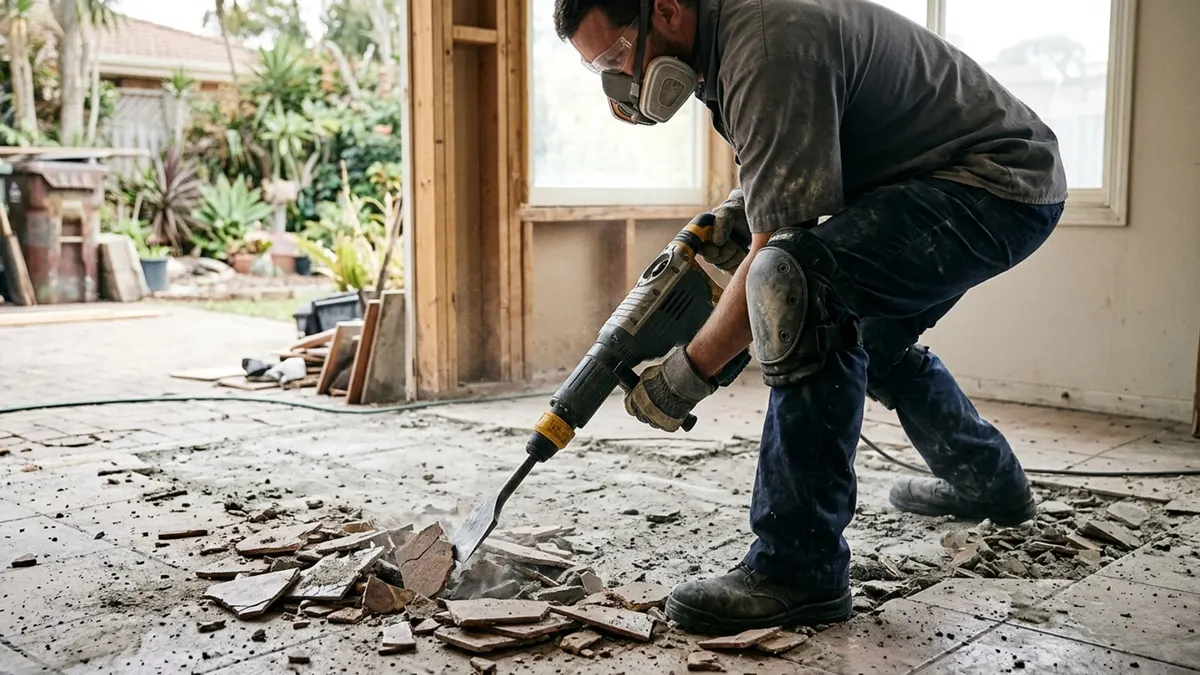
Demolition Hammers for Tile Removal and Chipping: SDS-Max and Hex (2026)
From a 13 lb tile breaker to a 35 lb hex hammer, matched to the job and the bit system.
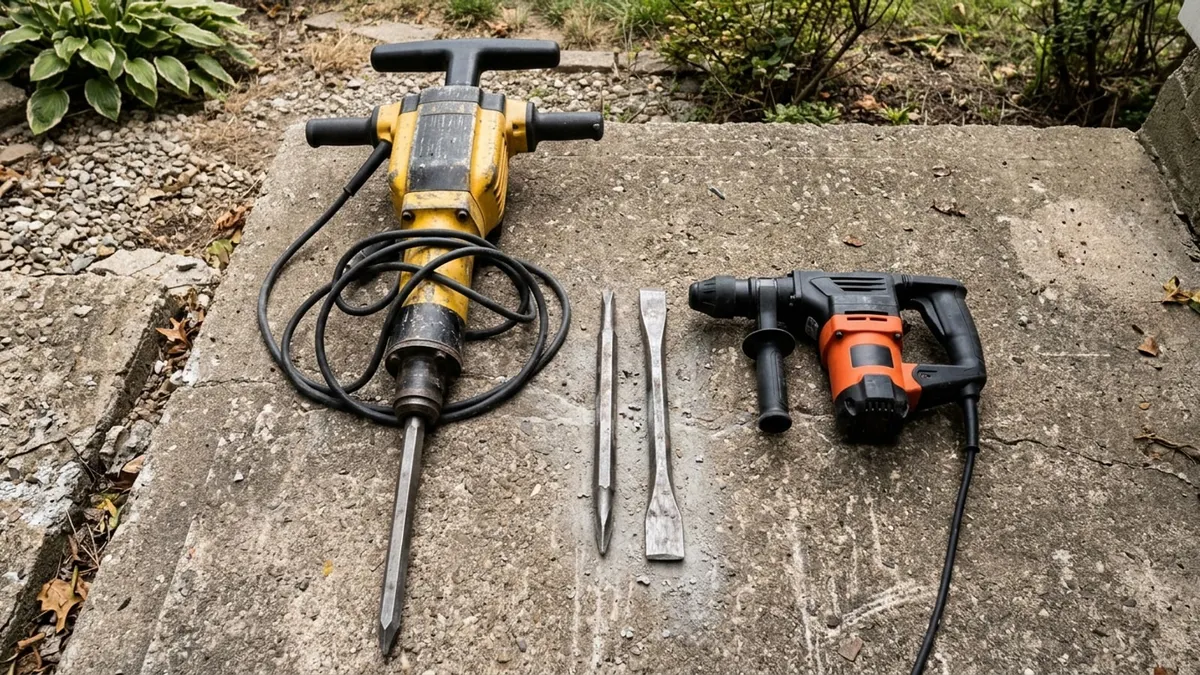
Jackhammer vs Demolition Hammer: Which One Does Your Job Need?
Breakers use their weight to smash slabs; demolition hammers chip, scrape and work on walls.
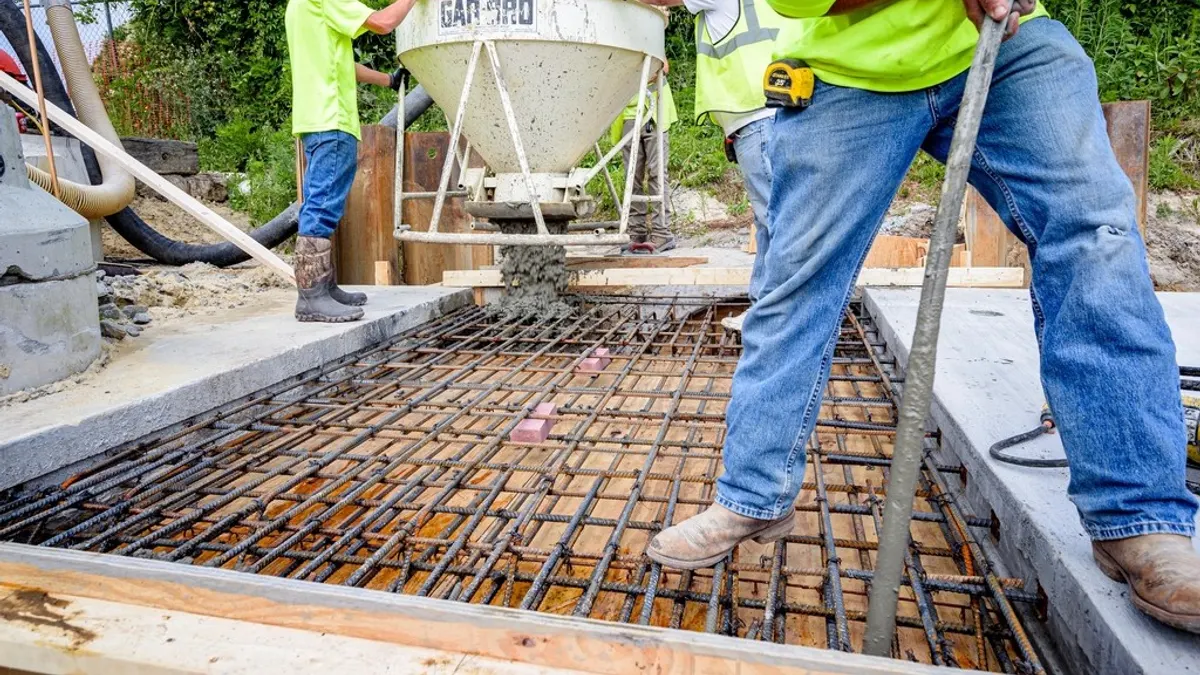
Rebar Cutters and Benders: Manual and Electric Tools for #3 to #5 Rebar (2026)
Manual cutter-benders for footings and walls, an electric tool for volume, and rebar safety.