
Jackhammer vs Demolition Hammer: Which One Does Your Job Need?
Jackhammer vs demolition hammer: weight, impact energy, bit systems and the jobs each suits, from breaking slabs to removing tile, with real tools compared.
Affiliate disclosure: product links on this page go to Amazon or to the maker's own store. As an Amazon Associate we earn from qualifying purchases, at no extra cost to you; links to makers' own stores earn us nothing. No retailer or brand sees our picks before they are published or has any say in them. How we choose.
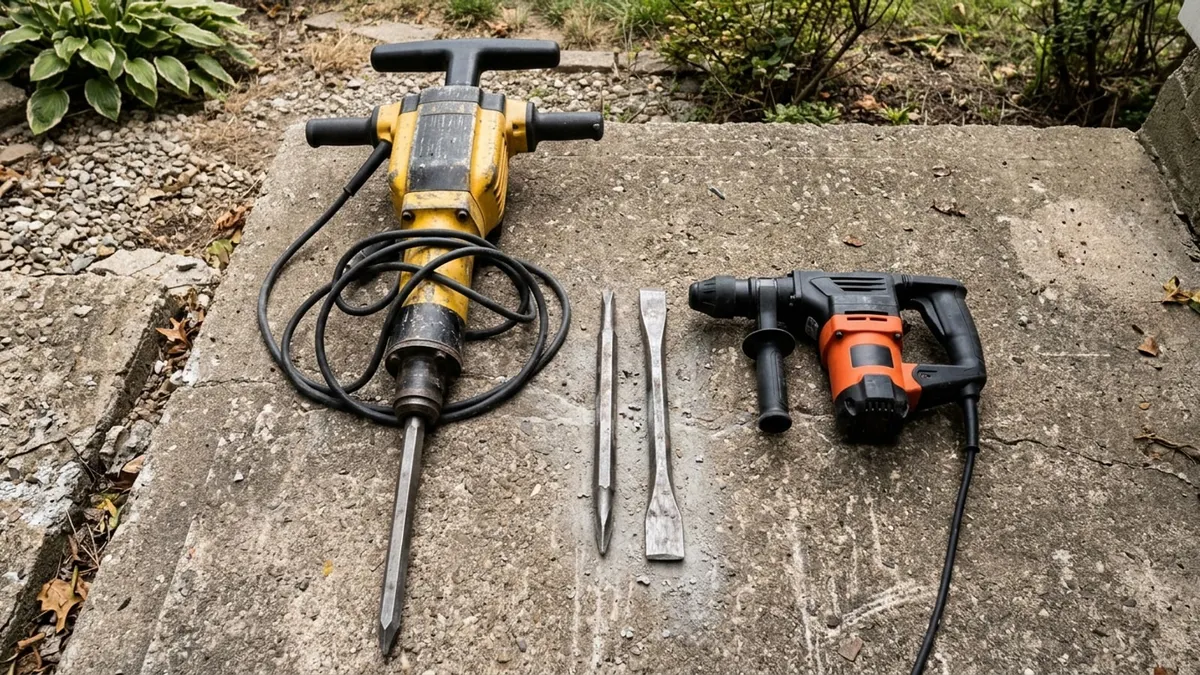
Use a jackhammer (breaker hammer) to break slabs, footings and thick concrete from above; use a demolition hammer to remove tile, chip, and work on walls or overhead. Breakers weigh 60 to 70 lb and rate 40-plus ft-lb of impact: Bosch's BH2770VC lists 43 ft-lb at about 63 lb. Demolition hammers weigh roughly 12 to 35 lb: Bosch's 11316EVS lists 12.4 ft-lb at 23 lb.
Side by side
| Jackhammer (breaker) | Demolition hammer | |
|---|---|---|
| Weight | About 60 to 70 lb | About 12 to 35 lb |
| Impact energy | Bosch BH2770VC 43 ft-lb; Makita HM1810X3 46.5 ft-lb | Bosch 11321EVS 6.1; Bosch 11316EVS 12.4; Makita HM1203C 18.8; Makita HM1307CB 25.7 ft-lb |
| Bits | 1-1/8 in hex | SDS-max, 5/8 in hex or 1-1/8 in hex |
| Used | Pointing down, weight does the work | Any angle: floors, walls, overhead |
| Best for | Slabs, footings, steps, thick concrete | Tile, chipping, trenching in slabs, openings in walls |
Figures from the makers' listings and Bosch's product page.
Choosing
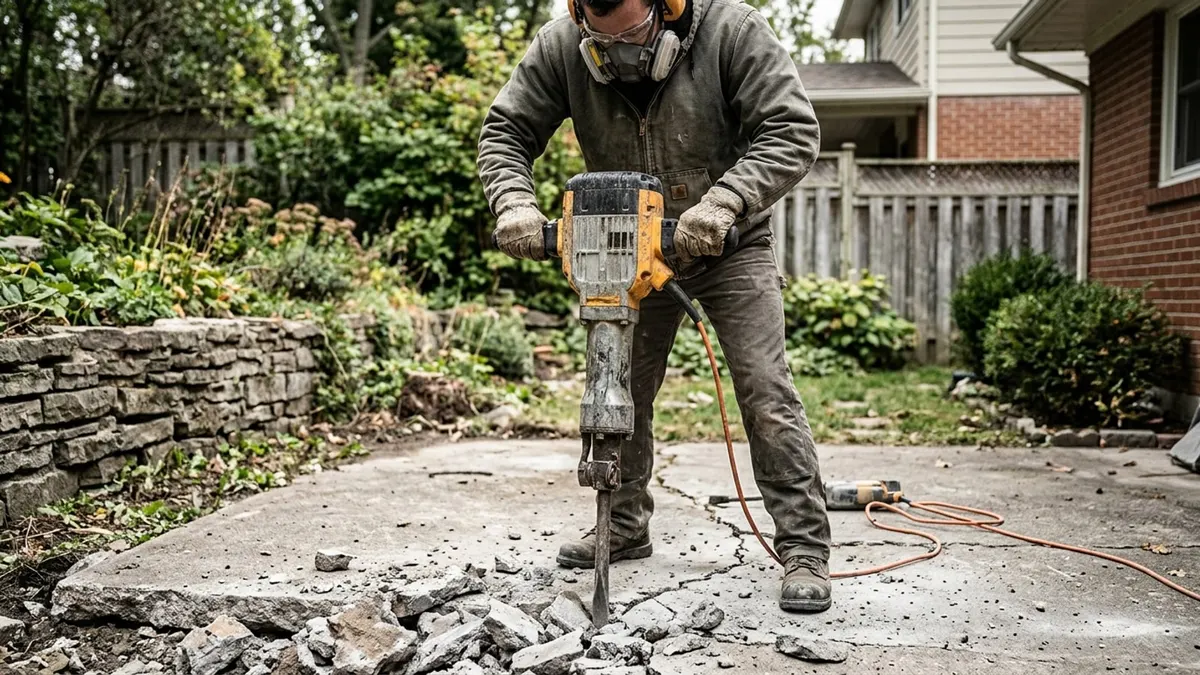
- Breaking a patio or driveway: a breaker. See jackhammers.
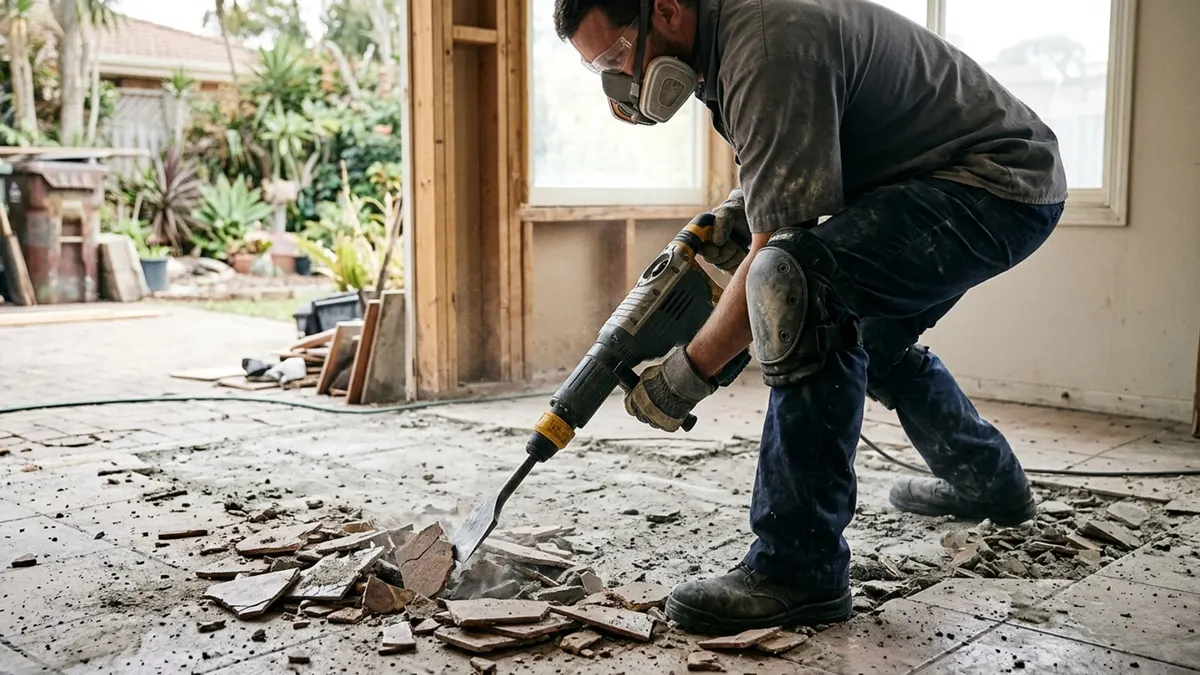
- Removing floor tile: a demolition hammer with a wide scraping chisel. See demolition hammers.
- Cutting a trench in a slab for plumbing: score it with a concrete saw, then chip with a demolition hammer.
- Both jobs: a heavy demolition hammer like the 35 lb Makita HM1307CB bridges the gap.
Energy for each pound you hold
Dividing impact energy by weight shows why the two tools are built so differently (our arithmetic from the makers' figures). The Bosch 11321EVS gives about 0.45 ft-lb per pound and the 11316EVS about 0.54. The 35 lb Makita HM1307CB reaches about 0.73, and the 63 lb Bosch BH2770VCD about 0.68. The breaker does not hit much harder for its weight than a heavy demolition hammer. It hits three and a half times harder than the 11316EVS because it weighs nearly three times as much, and you can only use that weight pointing down.
What each is like to use
A breaker stands on its bit. You steer it and let it drop, and between spots you move 60 to 70 lb, which is why Bosch sells its breakers with a cart. A demolition hammer is held the whole time, so the makers put their effort into the handles: Bosch lists a 360 degree auxiliary handle and vibration control on its SDS-max hammers, and Makita an internal counterbalance on its breaker. For work above your knees, choose the lighter tool.
Budget hammers
Budget breakers list large impact numbers in joules without a test method; Bosch states its rating to the EPTA procedure. Compare weight and trusted ratings rather than unverified claims.
The dust rule is the same for both
OSHA's silica standard for construction has one row for both tools: jackhammers and handheld powered chipping tools. It offers two controls. One is a water delivery system that puts a continuous stream or spray of water on the point of impact. The other is a commercially available shroud with a dust collector that pulls the airflow the tool maker recommends and has a filter at least 99 percent efficient with a filter-cleaning mechanism. Outdoors, with either in use, the table asks for no respirator up to four hours a day and a protection factor of 10 after that. Indoors it asks for the respirator throughout, with exhaust so dust does not build up. Tile removal is indoor work, so the lighter tool is often the one the indoor column applies to.
If you also need holes
Neither tool drills. Berserker and Deshuo both say their hammers are hammer-only, and a breaker has no rotation at all. Anchor holes and dowel holes need a rotary hammer, and OSHA's table has its own row for those: a shroud or cowling with a dust collector, and a HEPA-filtered vacuum to clean the holes.
Power
Bosch says its 15 amp BH2770VCD runs on any 115 or 120 V, 15 amp outlet or a 2,500 W portable generator. The demolition hammers here are listed at 11 to 14 amps. Budget breakers are listed at 2,200 W, which at 110 to 120 V is 18 to 20 amps (our arithmetic), more than a 15 amp circuit is rated for. Check the nameplate before you plan the day around an outlet in the garage.
A plumbing trench in a slab
This is the job that uses both kinds of tool, and a saw. Mark the trench and call 811 if any of it runs outdoors. Cut both edges with a concrete saw that feeds water to the blade, which is the control OSHA's table gives for handheld saws. Break the strip between the cuts with a demolition hammer and a point chisel, and lift the pieces out. A breaker speeds up a long trench in a thick slab; in a 4 inch floor the demolition hammer is enough and easier to control near the walls.
Reading a listing
Three things on a listing tell you more than the headline number. The first is whether the impact energy names a test: Bosch states its figure to the EPTA procedure, and budget listings usually name nothing. The second is the unit. One foot-pound is about 1.36 joules, so a budget breaker's 66 J claim is about 49 ft-lb, more than Bosch or Makita claim for 60 to 70 lb tools (our arithmetic). The third is the weight, which is hard to exaggerate and is the best single guide to what a hammer will do.
Dust that stays behind
The job is not over when the tool stops. OSHA's fact sheet says not to dry sweep or blow dust with compressed air where another method is available, so wet the rubble before shoveling and vacuum fine dust with a filtered vacuum. It also notes that silica diseases usually appear after years of exposure, which is the reason to treat a weekend job the way a contractor has to treat a career.
Safety
OSHA lists jackhammers and handheld powered chipping tools among the main sources of silica dust. Control dust with water or extraction, wear a respirator, and protect eyes, ears, hands and feet. See silica dust safety.
Frequently asked questions
Is a demolition hammer the same as a jackhammer?
No. A jackhammer (breaker) is a heavy tool used pointing down to break slabs; a demolition hammer is lighter and works at any angle for chipping and tile.
Can a demolition hammer break a concrete slab?
Thin slabs, slowly. Heavier demolition hammers like the 35 lb Makita HM1307CB break more; a breaker is faster for full slabs.
Which is better for tile removal?
A demolition hammer with a wide scraping chisel. A breaker is too heavy and would damage the subfloor.
How much impact energy do I need to break concrete?
Breakers rated around 43 to 47 ft-lb (Bosch BH2770VC, Makita HM1810X3) handle slabs and footings. Lighter tools work but take longer.
Do I need a respirator to use a jackhammer?
By OSHA's Table 1, not outdoors for four hours or less in a day if water is sprayed on the point of impact or a shroud and dust collector are fitted. Beyond four hours, or anywhere indoors, it calls for a respirator with an assigned protection factor of at least 10.
Sources
Cover image: Illustration: Construction Gear Review (AI-generated)
Related guides
Demolition Hammers for Tile Removal and Chipping: SDS-Max and Hex (2026)
From a 13 lb tile breaker to a 35 lb hex hammer, matched to the job and the bit system.
Electric Jackhammers for Breaking Concrete: Breaker Hammers Compared (2026)
Pro breaker hammers with measured impact energy, budget hammers with bigger claims, and how to tell the difference.
Rebar Cutters and Benders: Manual and Electric Tools for #3 to #5 Rebar (2026)
Manual cutter-benders for footings and walls, an electric tool for volume, and rebar safety.