
Concrete Block Calculator: How Many Cinder Blocks and Bags of Mortar
Free concrete block calculator: enter wall length and height to get the number of standard 8x8x16 blocks, bags of mortar mix and courses, with the math shown.
Affiliate disclosure: product links on this page go to Amazon or to the maker's own store. As an Amazon Associate we earn from qualifying purchases, at no extra cost to you; links to makers' own stores earn us nothing. No retailer or brand sees our picks before they are published or has any say in them. How we choose.
A standard 8 x 8 x 16 inch block covers 8 x 16 inches of wall once the mortar joint is counted, so a wall takes 1.125 blocks per square foot. Enter the wall's length and height and the calculator gives the block count, the number of 80 lb bags of mortar mix (Quikrete says each lays up to 13 standard blocks) and the number of courses.
How many concrete blocks?
Blocks
90
80 sq ft of wall at 1.125 per sq ft
80 lb bags of mortar mix
7
Up to 13 blocks per bag
Courses
6
8 in per course, rounded up
Counts standard 8 x 8 x 16 in blocks laid in running bond. Nominal size includes the mortar joint (Angelus Block), so each block covers 8 x 16 in of wall. Mortar uses Quikrete's figure of up to 13 standard blocks per 80 lb bag of Mortar Mix, so treat the bag count as a minimum. Corners, half blocks, lintels and core fill are not counted.
Where the numbers come from
- Block face: Angelus Block explains that nominal dimensions equal the specified dimensions plus the mortar joint, and lists the 8 x 8 x 16 unit at 7.625 x 7.625 x 15.625 inches. So each block plus its joint covers 8 x 16 = 128 square inches, and 144 / 128 = 1.125 blocks per square foot.
- Mortar: Quikrete's Mortar Mix data sheet says each 80 lb bag will lay up to 37 standard bricks or 13 standard 8 x 8 x 16 inch blocks. "Up to" means the bag count is a minimum.
- Courses: wall height in inches divided by 8, rounded up.
Worked example
A wall 20 ft long and 4 ft high is 80 square feet: 90 blocks, at least 7 bags of mortar mix, in 6 courses.
Counting by the course
A quick check on the result: each standard block is 16 inches long with its joint and each course is 8 inches high. A 20 ft wall is 240 inches, so 15 blocks to a course, and a 4 ft wall is 6 courses: 90 blocks, the same as the square-foot method (our arithmetic). Angelus Block notes that a block's actual dimensions may differ from the specified ones by up to 1/8 inch under ASTM C90, which the mortar joints absorb.
Mixing and laying the mortar
Quikrete's Mortar Mix is a Type N mortar under ASTM C270. Its data sheet gives the method: about 5 quarts of water per 80 lb bag, with a maximum expected below 6 quarts; pour the mix into the water and mix for at least 5 minutes, by hand or in a paddle-type mortar mixer; and stop when a 1/2 inch layer stays on a trowel held nearly vertical. Lay a full bed 1/2 to 3/4 inch thick, press each block down and against its neighbor with a slight twist, and tool the joints when they are thumbprint hard, which the sheet says makes them watertight.
Angelus Block separates three terms that get mixed up at the supply yard. Specified dimensions are what the block is made to, actual dimensions are what a given block measures, and nominal dimensions are the specified size plus the mortar joint. Order and calculate in nominal sizes; measure openings against specified ones.
What it does not count
- Corner and half blocks, cap blocks, lintels and bond beams.
- Grout or concrete to fill cores, and rebar. Any wall that retains soil or carries a load needs a design that meets local code.
- The footing: work out its volume with the concrete calculator.
Tools for block work
Cutting block is a job for a concrete saw with water control (see silica dust safety); a drum mixer handles mortar for a long wall.
Frequently asked questions
How many concrete blocks per square foot?
1.125 for standard 8 x 8 x 16 inch blocks: each block plus its mortar joint covers 8 x 16 inches, or 128 square inches.
How many blocks does one bag of mortar lay?
Quikrete says each 80 lb bag of its Mortar Mix lays up to 13 standard 8 x 8 x 16 inch blocks, so plan on at least one bag per 13 blocks.
What are the actual dimensions of an 8x8x16 block?
Angelus Block lists the specified dimensions as 7.625 x 7.625 x 15.625 inches. The nominal 8 x 8 x 16 size includes the mortar joint.
How many blocks for a 4 ft high, 20 ft long wall?
About 90 blocks (80 square feet at 1.125 per square foot), in 6 courses, before corners and breakage.
How much water goes in a bag of mortar mix?
Quikrete's Mortar Mix data sheet says about 5 quarts per 80 lb bag, with a maximum expected below 6 quarts, mixed for at least 5 minutes until a 1/2 inch layer stays on a trowel held nearly vertical.
Sources
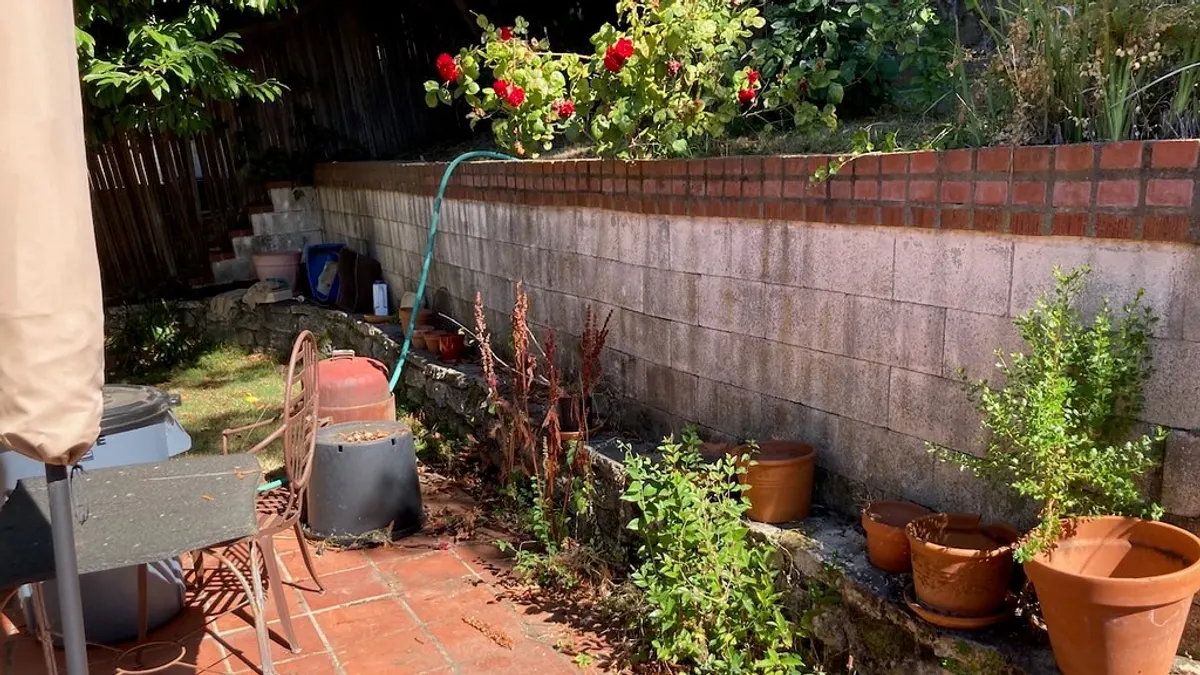
Cover photo: back yard retaining wall IMG_5507 by wbaiv, CC BY-SA 2.0, via Flickr. Cropped.
Related guides
Concrete Calculator: Cubic Yards and Bags for Slabs, Footings and Post Holes
Volume in cubic feet and yards, bag counts by size, and the weight of the wet concrete.
Concrete Mixers for Home Projects: Drum and Poly Drum Cement Mixers (2026)
Five electric drum mixers, how many bags each really takes, and steel vs poly drums.
Concrete Saws for Homeowners: Electric, Gas Cut-Off and Walk-Behind (2026)
Wet cutting is the rule: four saws compared on cut depth, power, water and warranty.