
Concrete Calculator: Cubic Yards and Bags for Slabs, Footings and Post Holes
Free concrete calculator: enter a slab, footing or post hole size to get cubic feet, cubic yards and the number of 80, 60, 50 or 40 lb bags, from Quikrete's yields.
Affiliate disclosure: product links on this page go to Amazon or to the maker's own store. As an Amazon Associate we earn from qualifying purchases, at no extra cost to you; links to makers' own stores earn us nothing. No retailer or brand sees our picks before they are published or has any say in them. How we choose.
Enter the size of your slab, footing or post holes and the calculator gives the volume in cubic feet and cubic yards, how many bags of each size you need, and what the wet concrete weighs. Bag counts use Quikrete's published yields for its Concrete Mix: an 80 lb bag makes about 0.60 cubic feet, a 60 lb bag 0.45, a 50 lb bag 0.375 and a 40 lb bag 0.30.
How much concrete do you need?
Volume
33.33 cu ft
1.23 cubic yards
Weight of wet concrete
2.33 tons
At about 140 lb per cu ft
80 lb bags
56
0.6 cu ft each
60 lb bags
75
0.45 cu ft each
50 lb bags
89
0.375 cu ft each
40 lb bags
112
0.3 cu ft each
Bag yields and the 140 lb per cubic foot unit weight are from Quikrete's Concrete Mix (No. 1101) data sheet; other brands differ slightly, so check the bag. The extra percentage is yours to set: add some for an uneven base and spillage. Holes are figured as cylinders; a post set in the hole takes up some of that volume, so the bag count is on the safe side.
How it works
- Volume: length times width times thickness for a slab (thickness converted from inches to feet), or pi times the radius squared times the depth for each round hole.
- Cubic yards: cubic feet divided by 27.
- Bags: cubic feet divided by the bag's yield, rounded up.
- Weight: Quikrete gives a unit weight of about 140 lb per cubic foot for its Concrete Mix.
Bag yields (Quikrete Concrete Mix)
| Bag | Yield | Bags per cubic yard |
|---|---|---|
| 80 lb | 0.60 cu ft | 45 |
| 60 lb | 0.45 cu ft | 60 |
| 50 lb | 0.375 cu ft | 72 |
| 40 lb | 0.30 cu ft | 90 |
Bags per cubic yard are our arithmetic: 27 cubic feet divided by the yield. Other brands publish their own yields; check the bag.
Worked example
A 10 by 10 ft shed pad 4 inches thick is 10 x 10 x 0.333 = 33.3 cubic feet, or 1.23 cubic yards. That is 56 bags of 80 lb mix, or about 2.3 tons of wet concrete. At that size, compare the cost and labor of bags against a ready-mix delivery.
Bags or ready-mix?
- Bags suit post holes, footings, steps and small pads. Quikrete says to allow at least 1 cubic foot of mixer capacity for each 80 lb bag mixed at one time, so a typical home mixer handles a few bags per batch; see concrete mixers.
- Ready-mix arrives by truck, measured in cubic yards. For larger slabs, the number of bags and the mixing time add up fast.
How much extra to allow
The National Ready Mixed Concrete Association's ordering guide says to order 4 to 10 percent more than the estimate from the plan dimensions, to cover an uneven base and other contingencies, and to avoid having to send for a small clean-up load. Set the calculator's Extra field in that range. The guide also gives the size of a delivery: truck mixers carry 8 to 12 cubic yards.
For posts, Quikrete's Fast-Setting Concrete Mix comes in 60 lb bags that yield about 0.45 cubic feet, the same as a 60 lb bag of Concrete Mix, so the 60 lb result applies to both.
The bag yields above assume the mix is made as Quikrete directs. Its typical strengths, 2,500 psi at 7 days and 4,000 psi at 28 days, are for concrete mixed to a 2 to 3 inch slump; extra water makes more volume per bag and weaker concrete.
Before you pour
Quikrete's data sheet says its Concrete Mix is for pours 2 inches thick or more, and to tamp and compact the sub-base until firm before placing concrete. A plate compactor or hand tamper does that job. Mixing steps are in how to mix concrete; post-specific numbers are in concrete per fence post.
Frequently asked questions
How many 80 lb bags of concrete make a yard?
About 45. Quikrete says an 80 lb bag of its Concrete Mix yields about 0.60 cubic feet, and a cubic yard is 27 cubic feet.
How much concrete do I need for a 10x10 slab?
At 4 inches thick, about 33.3 cubic feet or 1.23 cubic yards: 56 bags of 80 lb mix at Quikrete's 0.60 cubic feet per bag.
How much does a yard of concrete weigh?
Quikrete gives a unit weight of about 140 lb per cubic foot for its Concrete Mix, so a cubic yard weighs about 3,780 lb, or nearly 1.9 tons.
How thick should a concrete slab be?
It depends on the use and local code. Quikrete's Concrete Mix is rated for pours 2 inches thick or more; patios and shed pads are commonly 4 inches. Check your plans and local rules for driveways and structural slabs.
Should I add extra concrete?
Yes. The National Ready Mixed Concrete Association advises ordering 4 to 10 percent more than the estimate from the plan dimensions. The calculator has an Extra field so you can set the percentage.
Sources
- Concrete Mix No. 1101 data sheet, Quikrete
- Quikrete Concrete Mix product page, Quikrete
- CIP 31: Ordering Ready Mixed Concrete, National Ready Mixed Concrete Association
- Fast-Setting Concrete Mix No. 1004-60 data sheet, Quikrete
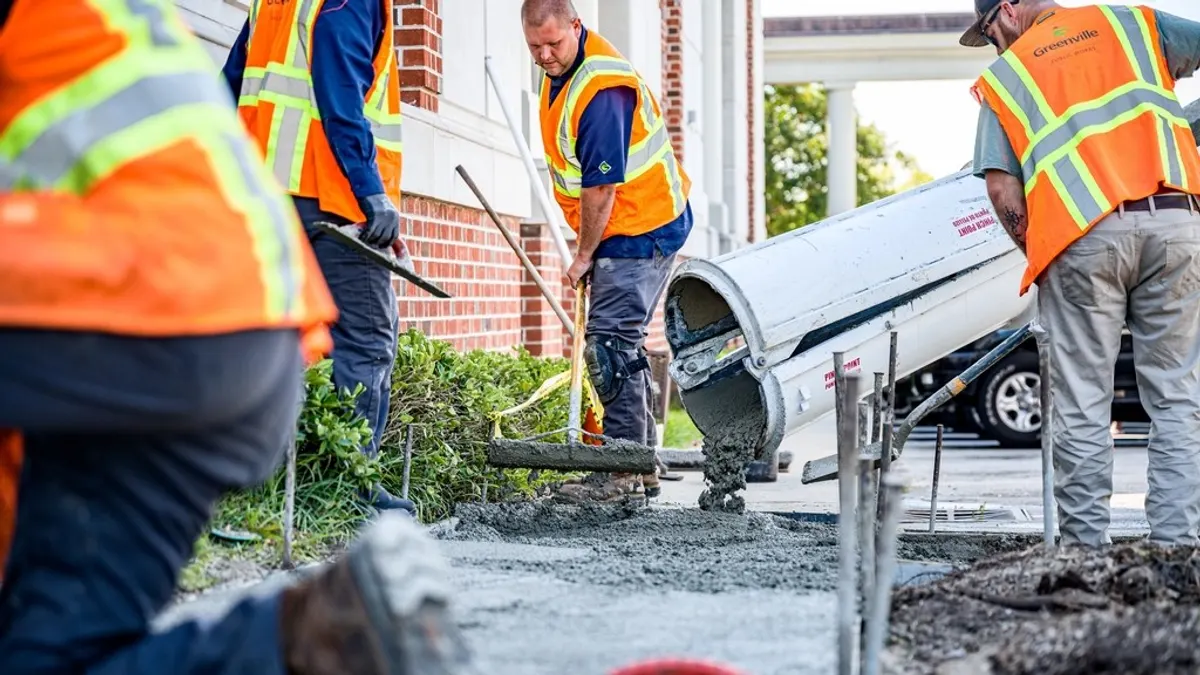
Cover photo: Public Works crew pours new, CC0 1.0, via rawpixel. Cropped.
Related guides
Concrete Block Calculator: How Many Cinder Blocks and Bags of Mortar
Blocks, 80 lb bags of mortar mix and courses for a standard 8 x 8 x 16 block wall.
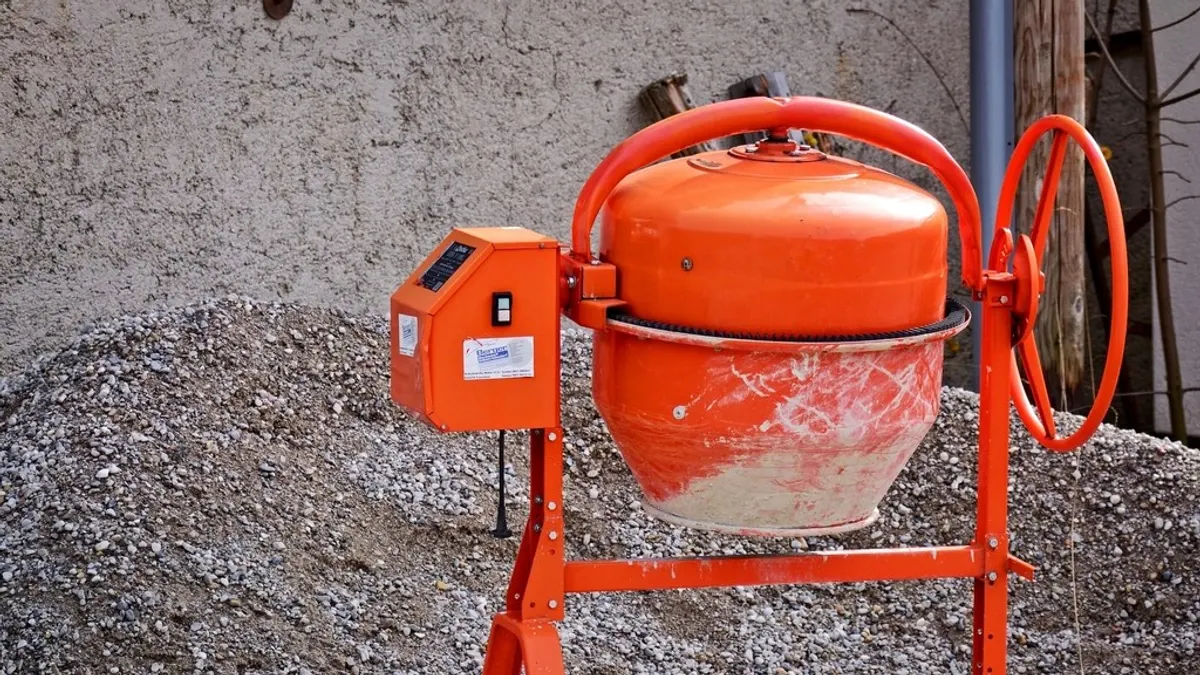
Concrete Mixers for Home Projects: Drum and Poly Drum Cement Mixers (2026)
Five electric drum mixers, how many bags each really takes, and steel vs poly drums.
Concrete Saws for Homeowners: Electric, Gas Cut-Off and Walk-Behind (2026)
Wet cutting is the rule: four saws compared on cut depth, power, water and warranty.