
Gravel Calculator: Cubic Yards and Tons of Gravel, Sand, Stone or Topsoil
Free gravel calculator: enter length, width and depth to get cubic yards and tons of crushed stone, pea gravel, road base, sand or topsoil, with the densities shown.
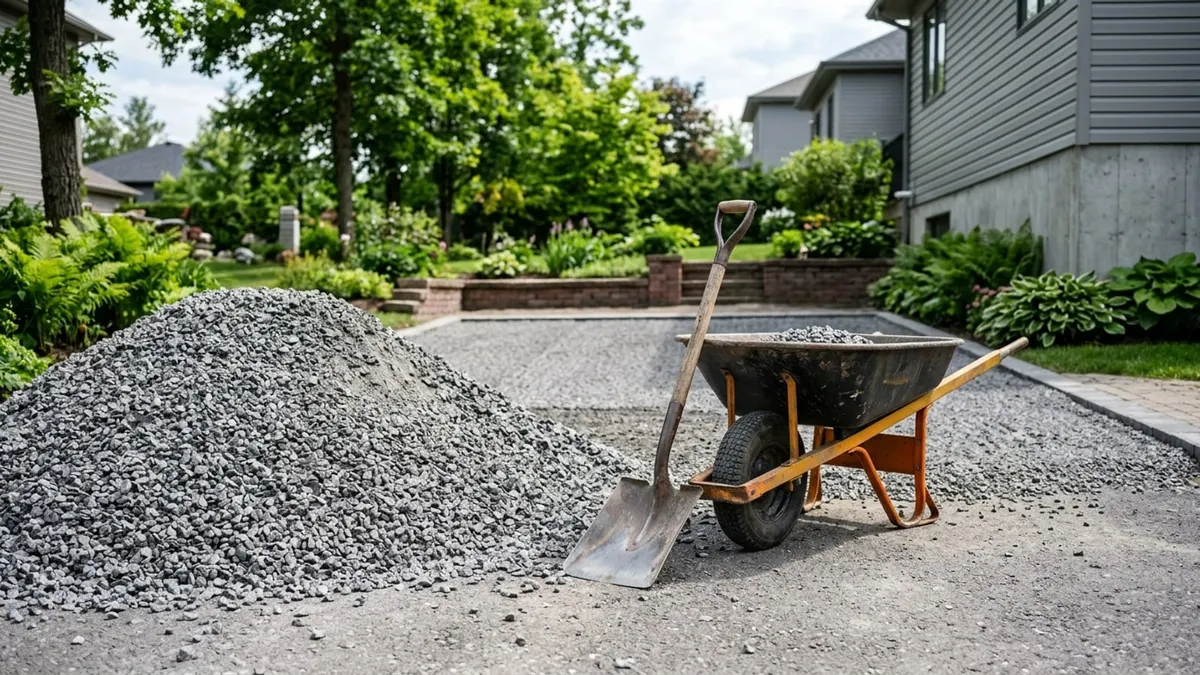
Affiliate disclosure: product links on this page go to Amazon or to the maker's own store. As an Amazon Associate we earn from qualifying purchases, at no extra cost to you; links to makers' own stores earn us nothing. No retailer or brand sees our picks before they are published or has any say in them. How we choose.
Enter the area and depth, pick the material, and the calculator gives cubic yards and tons. Tons use indicative loose bulk densities published by Designing Buildings Wiki: about 1.35 short tons per cubic yard for 3/4 to 1 inch crushed stone and pea gravel, 1.55 for road base or crusher run, 1.3 for fill sand and 1.1 for topsoil. Your supplier's figure beats any table, so ask for it when you order.
How much gravel, sand or soil?
Cubic yards
2.47
66.7 cu ft
Tons (short)
3.33
At 1.35 tons per cubic yard
Area covered
200 sq ft
At 4 in deep
Densities are the indicative loose bulk densities published by Designing Buildings Wiki; real loads vary with the quarry, grading, moisture and compaction. Suppliers sell by the ton or the yard, so ask yours for its figure. Material compacts when you tamp it: order for the finished, compacted depth and add a margin.
How it works
- Volume: length times width times depth (inches converted to feet) gives cubic feet.
- Cubic yards: cubic feet divided by 27.
- Tons: cubic yards times the material's density in short tons per cubic yard.
Densities used
| Material | Short tons per cubic yard |
|---|---|
| Crushed stone, 19 to 25 mm (3/4 to 1 in) | 1.35 |
| Crushed stone, 38 to 63 mm | 1.25 |
| Pea gravel, 3 to 10 mm | 1.35 |
| Road base / crusher run | 1.55 |
| Stone dust / screenings | 1.35 |
| Concrete sand | 1.35 |
| Fill or building sand | 1.30 |
| Topsoil | 1.10 |
| Crushed concrete, 19 to 25 mm | 1.20 |
Designing Buildings Wiki stresses these are indicative loose densities, not universal values: actual density varies with the source, grading, particle shape, moisture, handling and compaction. Where compaction is required, it says quantities should be based on the compacted design volume.
How deep?
For a paver patio or walkway, the Concrete Masonry and Hardscapes Association (CMHA) calls for at least 4 inches of compacted base over well-drained soil; a residential driveway needs at least 6 inches. Base goes down in lifts of about 4 to 6 inches, each compacted before the next. Details in plate compactors for pavers.
Worked example
A 20 by 10 ft area 4 inches deep is 66.7 cubic feet, or 2.47 cubic yards. In 3/4 inch crushed stone at 1.35 tons per yard, that is about 3.3 tons. Because loose stone compacts, order a little more than the finished depth calls for.
Which material for which layer
The calculator works for any of the materials in the table, but they are not interchangeable. For a paver base, the Concrete Masonry and Hardscapes Association uses a graded aggregate base of the kind specified under asphalt paving, which corresponds to the road base or crusher run row. For the 1 inch bedding layer on top it specifies concrete sand, and it says stone dust, limestone screenings and masonry sand should never be used there. Recycled concrete aggregate is acceptable for pedestrian paving in its guide, with a warning that it can leave white efflorescence on the pavers; Designing Buildings Wiki lists crushed concrete paver base at about 1.3 short tons per cubic yard.
The same table has lighter materials if you are ordering for a garden: about 0.85 tons per cubic yard for a garden soil mix, 0.6 for compost and 0.3 for bark mulch. Its own caution applies to all of them: no universal compaction allowance should be assumed, so ask the supplier how much to add. And before you dig out for any base, contact 811 so buried lines are marked.
Need concrete instead? Use the concrete calculator. Moving the material? See power wheelbarrows.
Frequently asked questions
How many tons of gravel are in a cubic yard?
Roughly 1.25 to 1.55 short tons depending on the material, by Designing Buildings Wiki's indicative loose densities: about 1.35 for 3/4 inch crushed stone and pea gravel, 1.55 for road base. Ask your supplier for its figure.
How much gravel do I need for a 10x10 area?
At 4 inches deep, 33.3 cubic feet or 1.23 cubic yards, about 1.7 tons of 3/4 inch crushed stone at 1.35 tons per yard.
How deep should gravel be under pavers?
CMHA calls for at least 4 inches of compacted base under patios and walkways on well-drained soil, and at least 6 inches under residential driveways.
Does gravel compact?
Yes. Designing Buildings Wiki notes its figures are loose densities and that compacted quantities should be based on the compacted design volume. Order a margin above the finished depth.
Can I use stone dust under pavers?
Not as the bedding layer. The Concrete Masonry and Hardscapes Association says bedding sand should be concrete sand and that stone dust, limestone screenings and masonry sand should never be used for it, because they often do not compact uniformly and can hold up drainage.
Sources
- Converting between weight and volume for bulk construction materials, Designing Buildings Wiki
- PAV-TEC-002: Construction of Interlocking Concrete Pavements, Concrete Masonry and Hardscapes Association
- 811 Before You Dig, Common Ground Alliance
Cover image: Illustration: Construction Gear Review (AI-generated)
Related guides
Concrete Block Calculator: How Many Cinder Blocks and Bags of Mortar
Blocks, 80 lb bags of mortar mix and courses for a standard 8 x 8 x 16 block wall.
Concrete Calculator: Cubic Yards and Bags for Slabs, Footings and Post Holes
Volume in cubic feet and yards, bag counts by size, and the weight of the wet concrete.
Concrete Mixers for Home Projects: Drum and Poly Drum Cement Mixers (2026)
Five electric drum mixers, how many bags each really takes, and steel vs poly drums.