
Rent or Buy a Mini Excavator? How to Decide for Your Property
Rent or buy a mini excavator: compare total cost, days of work, hauling, storage, maintenance and resale, and the projects where owning one pays off.
Affiliate disclosure: product links on this page go to Amazon or to the maker's own store. As an Amazon Associate we earn from qualifying purchases, at no extra cost to you; links to makers' own stores earn us nothing. No retailer or brand sees our picks before they are published or has any say in them. How we choose.
Rent for a single project; buy when you have weeks of digging over the next few years, a trailer, and somewhere to store it. Rental rates vary by region, so get a quote that includes delivery and pickup for the days you need, multiply by the number of projects you foresee, and compare that with an imported 1 ton machine's purchase price plus a trailer, maintenance and what you could resell it for.
Side by side
| Rent | Buy | |
|---|---|---|
| Upfront cost | Per day or week | The machine, freight, and a trailer if you need to move it |
| Machine | A maintained dealer brand | Often an imported 1 to 2 ton machine |
| Transport | Delivery available | Your trailer and truck, rated for its weight |
| Maintenance | The rental company's | Yours: fluids, grease, hoses, tracks |
| Schedule | Pay while it sits, even in rain | Work when you like |
| At the end | Return it | Resell it, at a loss |
How to decide
- Count the days. List every job: drainage, stumps, a pond, grading, fence lines. Estimate machine days for each.
- Price the rental. Days times the local rate, plus delivery each time.
- Price ownership. Purchase plus freight, a trailer if needed, insurance, fluids and wear parts, minus a realistic resale value.
- Weigh the time value. Owning lets you work weekends over months, which rental clocks punish.
What renting costs
Rental marketplace DOZR publishes rates from its own quotes. Its 2026 guide, built on 1,193 rental quotes across the United States and Canada, puts the 1.5 to 4 ton class at $150 to $400 a day, $450 to $1,200 a week and $1,200 to $3,200 a month. Across every size in its data a week costs about 2.8 times a day and a month saves roughly 60 to 65 percent against the daily rate. Treat those as a range to check a local quote against, and ask whether delivery and pickup are included.
The pattern matters more than the exact figure. In the mini class a week costs about what three days do, so a three-day job is better booked as a week, with the spare days free. A job spread over four weekends is four separate rentals with four deliveries, or one month.
Break-even, per $1,000
We do not print purchase prices, which change daily, so here is the sum to do with your own. Take the purchase price, add freight and a trailer if you need one, and subtract what you expect to sell the machine for. For each $1,000 of that net cost, DOZR's range gives 2.5 to 6.7 days at daily rates, or about 0.8 to 2.2 weeks at weekly rates (our arithmetic). A net cost of $6,000 is therefore somewhere between 5 and 13 weeks of weekly rental. If the work you can see adds up to less than that, rent.
What the comparison leaves out
A rental quote is for a dealer-brand machine that someone else maintains and replaces if it fails. The imported machines sold online are not the same machine at a lower price: several listings give no dig depth or warranty, and parts come from the seller. On the other side, an owned machine has no clock. Rain, a late pipe delivery or a buried boulder cost nothing but time.
Storage and hauling are the costs people forget. A 1.2 ton machine weighs about 2,650 lb by the listings, more with a trailer under it, and it needs a dry place to sit between jobs and a vehicle rated to pull it to the next one.
A third option: hire the hole
For a single trench or a stump, an operator who brings a machine can cost less than either, because the delivery charges and the learning curve both disappear. Get that quote too before you decide between the other two.
Who should buy
- Acreage owners with ongoing land work.
- Owners doing a long, slow project such as clearing or a pond.
- Anyone who already owns a suitable trailer and truck.
Who should rent
- One trench, one patio dig, one stump.
- No storage or no way to haul.
- Anyone who wants a dealer-maintained machine for a critical job.
What the job needs from the machine
Match the machine to the deepest thing you will dig. The 1.2 ton imports list dig depths around 61 inches and the 1.8 ton machine about 75. A water line below frost, a footing or a septic repair may need more than a small machine reaches, and a rental yard will have the next size up for the week you need it. If one job on your list is out of a small machine's reach, renting for that job and doing the rest by hand or with a cheaper tool can beat owning the wrong size.
The rules do not change with the paperwork
Owned or rented, the same steps come first. Contact 811 a few business days ahead and wait for every utility. Where the digging nears a marked line, OSHA's excavation rule says its exact position has to be found by safe means first, which means by hand. Keep spoil at least 2 feet from the edge, and treat 5 feet as the depth where a trench needs sloping or a shield before anyone goes in; in the weakest soil OSHA's table allows a slope no steeper than 1-1/2 to 1.
Ask before you sign or order
For a rental: what the day and week rates include, the delivery and pickup charge, which buckets come with the machine, and who to call if it stops. For a purchase: the engine family and its EPA certificate, the warranty in writing, where parts ship from, and whether freight includes a lift gate. The answers to the second list take longer to get, so start asking early.
Either way
Call 811 a few business days before digging, and respect trench safety: OSHA requires protective systems for trenches 5 feet deep or more and names cave-ins as the greatest risk. If you buy, read buying an imported mini excavator and see our picks. For a single towable machine, consider a towable backhoe.
Frequently asked questions
Is it cheaper to rent or buy a mini excavator?
Renting is cheaper for one project. Buying can pay off with many days of work over several years, if you can haul and store the machine. Price both with your own rental quote.
What do I need to own a mini excavator?
Somewhere to store it, a trailer and tow vehicle rated for its weight if you move it, and time for maintenance such as fluids, greasing and hose checks.
Can I resell a mini excavator?
Usually, but at a loss. Imported machines resell for less than dealer brands, so do not count on recovering most of the price.
Do I need a license to operate a mini excavator on my property?
Rules vary by state and locality. Check local requirements, and always call 811 before digging.
How much does it cost to rent a mini excavator for a week?
Rental marketplace DOZR's 2026 guide puts 1.5 to 4 ton machines at $450 to $1,200 a week, from its own quotes in the United States and Canada. Ask for a local quote with delivery and pickup included.
Sources
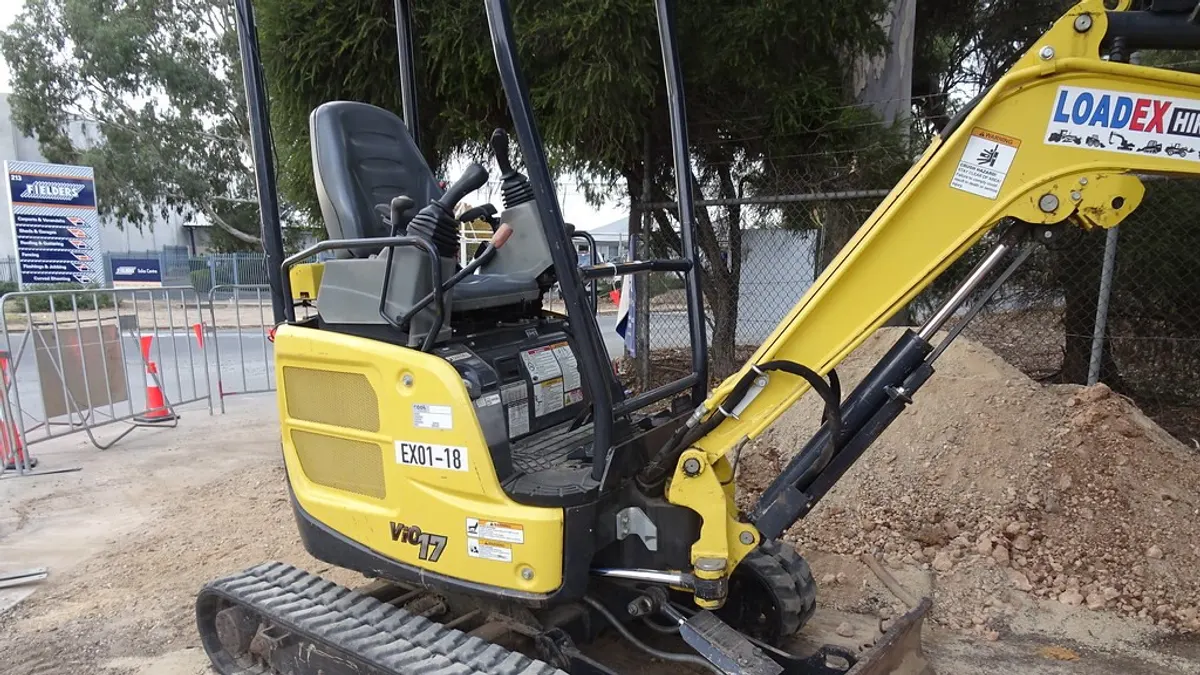
Cover photo: Mini Excavator by mikecogh, CC BY-SA 2.0, via Flickr. Cropped.
Related guides
Call 811 Before You Dig: How It Works and What the Marks Mean for You
The free call or click that gets buried lines marked, and the trench rules that keep you alive.
Construction Equipment for Homeowners: What to Buy or Rent for Each Project
Start from the project: the machine it needs, whether to own it, and the guide that sizes it.
Silica Dust When Cutting or Breaking Concrete: How to Protect Yourself
Why concrete dust is dangerous, and the water, vacuum and respirator steps OSHA's standard is built on.