
Power Trowels: Walk-Behind Concrete Finishers from 24 to 36 Inches (2026)
The best power trowels for slabs: 24, 28 and 36 inch walk-behind concrete finishers compared on engine, blade pitch, float pan and safety stop, plus when to rent.
Affiliate disclosure: product links on this page go to Amazon or to the maker's own store. As an Amazon Associate we earn from qualifying purchases, at no extra cost to you; links to makers' own stores earn us nothing. No retailer or brand sees our picks before they are published or has any say in them. How we choose.
For a garage or shop slab, the power trowel to buy is the Tomahawk 36 inch: a Honda GX160 engine, a 0 to 28 degree blade pitch, combination blades that go from floating to finishing without a blade change, and a float pan. For smaller pads, the VEVOR 24 inch has a 5.5 hp engine, a float pan and a centrifugal switch that shuts it off if you let go.
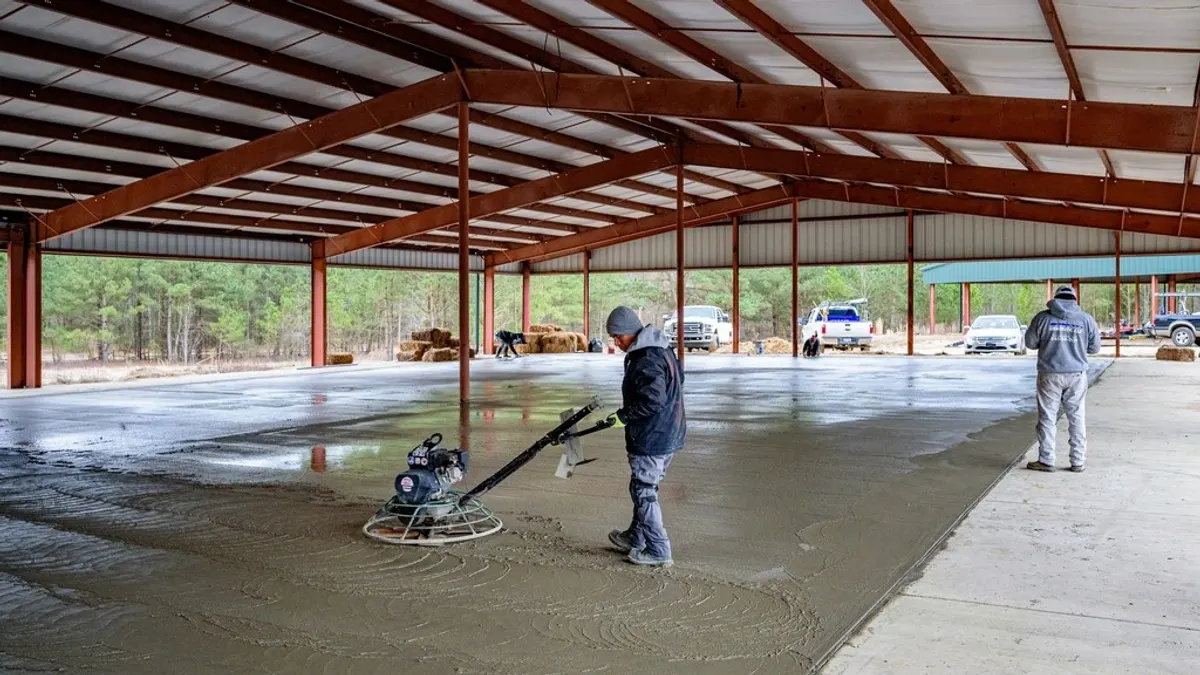
Timing matters more than the machine: Quikrete says to wait until all water has evaporated from the surface before troweling.
Our top picks at a glance
- Tomahawk 36 in power trowel (Honda 5.5 hp)
Width: 36 in · Engine: Honda GX160, 5.5 hp · Pitch: 0 to 28 degrees · Float pan: Yes
- Albott 36 in power trowel (GX160)
Width: 36 in · Engine: 5.5 hp GX160 · Pitch: 0 to 28 degrees · Float pan: Yes
- VEVOR 28.3 in power trowel
Width: 28.3 in · Engine: 1.5 hp Kohler · Pitch: 0 to 12 degrees · Float pan: Not listed
- VEVOR 24 in power trowel
Width: 24 in · Engine: 5.5 hp · Pitch: 0 to 18 degrees · Float pan: Yes
| Pick | Width | Engine | Pitch | Float pan | Buy |
|---|---|---|---|---|---|
| Tomahawk 36 in power trowel (Honda 5.5 hp)Best overall | 36 in | Honda GX160, 5.5 hp | 0 to 28 degrees | Yes | Amazon |
| Albott 36 in power trowel (GX160)Best 36 inch value | 36 in | 5.5 hp GX160 | 0 to 28 degrees | Yes | Amazon |
| VEVOR 28.3 in power trowelBest light-duty | 28.3 in | 1.5 hp Kohler | 0 to 12 degrees | Not listed | Amazon |
| VEVOR 24 in power trowelBest for small pads | 24 in | 5.5 hp | 0 to 18 degrees | Yes | Amazon |
Best overall
Tomahawk 36 in power trowel (Honda 5.5 hp)
A 36 inch trowel with a Honda engine, wide pitch range and combo blades.
- Width
- 36 in
- Engine
- Honda GX160, 5.5 hp
- Pitch
- 0 to 28 degrees
- Float pan
- Yes
Pros
- Honda engine
- Combo blades: float to finish without changing
- Works close to walls
Cons
- Costs the most here
The listing gives a Honda GX160 engine, a 36 inch working width with an independent rotating flywheel for working close to walls and corners, a 0 to 28 degree blade pitch, combination blades and a float pan.
Best 36 inch value
Albott 36 in power trowel (GX160)
A 36 inch trowel with a GX160-type engine, float pan and a kill switch rod.
- Width
- 36 in
- Engine
- 5.5 hp GX160
- Pitch
- 0 to 28 degrees
- Float pan
- Yes
Pros
- Red push rod stops the engine if control is lost
- 1-year manufacturer warranty
Cons
- Too wide for small pads and tight corners
Albott lists a 5.5 hp GX160 gasoline engine, a 36 inch working diameter, a 0 to 28 degree adjustable pitch, a float pan with four manganese steel blades, a red push rod that stops the engine instantly if control is lost, and a 1-year warranty.
Best light-duty
VEVOR 28.3 in power trowel
A 28.3 inch trowel with a small Kohler engine and a long control handle.
- Width
- 28.3 in
- Engine
- 1.5 hp Kohler
- Pitch
- 0 to 12 degrees
- Float pan
- Not listed
Pros
- 15.85 ft extension handle
- Light for one person
Cons
- Small engine
- Narrow pitch range
VEVOR lists a 1.5 hp Kohler engine (1.1 kW, 7,500 rpm), a 28.3 inch trowel diameter with four spring steel blades, a 0 to 12 degree pitch and a 15.85 ft extension handle that turns the machine on and off by rotating it.
Best for small pads
VEVOR 24 in power trowel
A 24 inch trowel with a 5.5 hp engine, float pan and an automatic shutoff.
- Width
- 24 in
- Engine
- 5.5 hp
- Pitch
- 0 to 18 degrees
- Float pan
- Yes
Pros
- Centrifugal switch shuts off automatically
- Float pan included
Cons
- Pitch stops at 18 degrees, against 28 on the Albott
VEVOR lists a 5.5 hp engine (4.1 kW, 3,600 rpm), a 24 inch finishing pan with four spring steel blades, a 0 to 18 degree pitch and a centrifugal ignition switch that shuts the engine off automatically.
How we chose
We compared working width, engine, pitch range, float pan and safety stop from the listings.
How a power trowel is used
- Wait. Quikrete's guidance is to let all water evaporate from the surface before troweling. Too early and the machine sinks and tears the surface.
- Float first. With the float pan on and blades flat, pass over the slab to embed aggregate and level ridges.
- Finish. Remove the pan, then raise the blade pitch a little with each pass as the slab stiffens for a smoother, harder surface.
Do not overwork the concrete, Quikrete adds. Mixing and placing steps are in how to mix concrete.
Which width
| Slab | Trowel |
|---|---|
| Small pads and walks | 24 in |
| Single garage, shop floor | 28 to 36 in |
| Large slabs | 36 in, or rent a ride-on |
Buy or rent?
A power trowel is used for a few hours per slab. If you pour one slab, renting usually makes more sense. Buy if you pour regularly.
Wear boots, gloves and eye and hearing protection, and run gas engines outdoors or in a well-ventilated space.
Where troweling falls in the pour
Quikrete's slab method puts troweling last. Fill the forms to full depth, strike off with a straight board, float at once with a darby or bull float, run an edger along the forms, cut control joints 1 inch deep every 6 to 8 feet, and only then wait for the surface water to go before troweling. Its data sheet lists power troweling among the finishes its Concrete Mix accepts.
How long the wait is
There is no fixed number of minutes. The National Ready Mixed Concrete Association says concrete normally sets within two to eight hours of mixing, and its cold-weather guide gives a rule of thumb: a drop of 20 F in concrete temperature roughly doubles the setting time. A slab poured on a cool morning can keep you waiting into the afternoon; on a hot, windy day the surface can stiffen before you are ready. The association's curing guide adds that the surface should be protected from drying out until final finishing, by fogging or an evaporation retarder.
Passes on a real slab
A 20 by 20 ft garage slab is 400 square feet. A 24 inch trowel crosses it in 10 lanes and a 36 inch trowel in 7 (our arithmetic, allowing nothing for overlap). Each pass is repeated as the slab stiffens, with the pitch raised each time, so the wider machine saves real time on a slab that size. That slab is also about 4.9 cubic yards at 4 inches thick, or 223 bags of 80 lb mix, which is ready-mix territory.
After the last pass
Finishing is not the end of the job. Quikrete says curing should start as soon as possible and run for 5 days at 70 F or above, or 7 days at 50 to 70 F. The association's curing guide puts the cost of skipping it at as much as half the concrete's potential strength if it is left to dry. A spray-on cure and seal goes on once the surface is hard; Quikrete says not to apply one if rain or temperatures below 50 F are expected within 24 hours.
If the slab comes by truck
The association's ordering guide says to order 4 to 10 percent more than the plan dimensions give, to tell the producer what you are pouring and how fast you can place it, and to be ready when the truck arrives, since concrete is perishable. Have the trowel fueled and on site before the pour starts, not on its way from the rental yard.
Cold days and hot ones
Weather changes the troweling window more than the machine does. The National Ready Mixed Concrete Association defines cold weather as more than three days in a row with an average temperature under 40 F, and says fresh concrete freezes below about 25 F and can lose more than half its potential strength if it does. It needs protecting until it reaches 500 psi, about two days after placing; Quikrete says 48 hours, with plastic sheeting and insulation blankets if it will drop below 32 F. On a cold slab, expect to wait a long time for the surface water to go, and do not start troweling early to beat the dark.
Heat works the other way. Quikrete warns that in hot, dry or windy weather water evaporates from the surface, which makes finishing harder and can cause shrinkage cracks. The association's advice is to keep the surface from drying out until final finishing, with fogging or an evaporation retarder. On those days a bigger trowel, or a second one, is cheap insurance against a slab that sets before you reach the far side.
Frequently asked questions
When can you power trowel concrete?
When all water has evaporated from the surface, per Quikrete, and the slab can bear the machine without it sinking. Float first, then finish with increasing blade pitch.
What size power trowel do I need?
A 24 inch trowel suits small pads and walks; 28 to 36 inch trowels suit garage and shop slabs.
What is a float pan for?
It covers the blades for the first pass, spreading the machine's weight to embed aggregate and level the surface before finishing.
Should I buy or rent a power trowel?
For a single slab, renting usually makes more sense. Buying pays off if you pour concrete regularly.
How long after pouring can you power trowel?
There is no fixed time. Quikrete says to wait until all water has evaporated from the surface. Concrete normally sets within two to eight hours of mixing, and a 20 F drop in its temperature roughly doubles the setting time, per the National Ready Mixed Concrete Association.
Sources
- Concrete Mix No. 1101 data sheet, Quikrete
- Quikrete Concrete Mix product page, Quikrete
- CIP 31: Ordering Ready Mixed Concrete, National Ready Mixed Concrete Association
- CIP 11: Curing In-Place Concrete, National Ready Mixed Concrete Association
- CIP 27: Cold Weather Concreting, National Ready Mixed Concrete Association
Cover photo: Wildwood Park Development Concrete surface, CC0 1.0, via rawpixel. Cropped.
Related guides
Concrete Block Calculator: How Many Cinder Blocks and Bags of Mortar
Blocks, 80 lb bags of mortar mix and courses for a standard 8 x 8 x 16 block wall.
Concrete Calculator: Cubic Yards and Bags for Slabs, Footings and Post Holes
Volume in cubic feet and yards, bag counts by size, and the weight of the wet concrete.
Concrete Mixers for Home Projects: Drum and Poly Drum Cement Mixers (2026)
Five electric drum mixers, how many bags each really takes, and steel vs poly drums.