
How to Mix Concrete: By Hand or in a Mixer, Water per Bag, Placing and Curing
How to mix concrete from bags: water per bag, mixing by hand or in a drum mixer, placing and finishing a slab, control joints and curing, from Quikrete's data sheet.
Affiliate disclosure: product links on this page go to Amazon or to the maker's own store. As an Amazon Associate we earn from qualifying purchases, at no extra cost to you; links to makers' own stores earn us nothing. No retailer or brand sees our picks before they are published or has any say in them. How we choose.
For each 80 lb bag of Quikrete Concrete Mix, start with about 6 pints of water, mix until you get a stiff, moldable consistency with no dry pockets, and add water only as needed, up to about 9 pints. Place it into the forms in one continuous pour, strike it off, float it, cut control joints every 6 to 8 feet, wait for the surface water to evaporate before troweling, then keep it curing for 5 days in warm weather or 7 in cooler weather. Every number here is from Quikrete's data sheet.
Water per bag (Quikrete Concrete Mix)
| Bag | Start with | Maximum |
|---|---|---|
| 40 lb | 3 pints | 4-1/2 pints |
| 50 lb | 3-1/2 pints | 5-1/2 pints |
| 60 lb | 4 pints | 7 pints |
| 80 lb | 6 pints | 9 pints |
| 90 lb | 7 pints | 10 pints |
Too much water weakens concrete. Add it gradually.
In a mixer
- Allow at least 1 cubic foot of mixer capacity for each 80 lb bag in the batch.
- Add about 6 pints of water per 80 lb bag to the drum first.
- Start the mixer and add the concrete mix.
- If it gets too stiff to mix, add water a little at a time until it is workable. With a slump cone, Quikrete targets 2 to 3 inches of slump.
Mixer picks are in concrete mixers.
By hand
- Empty the bag into a wheelbarrow or mixing tub.
- Add about 6 pints of water per 80 lb bag.
- Work it with a shovel, rake or hoe, adding water as needed, until it is stiff and moldable with no dry pockets and no standing puddles.
Placing a slab
- Compact the sub-base until firm (a plate compactor or tamper), set the forms, and dampen the sub-grade without leaving puddles.
- Fill the forms to full depth, working continuously from one end to the other; partial-depth fills can leave cold joints.
- Strike off with a straight board in a sawing motion, then float with a darby or bull float.
- Run an edging tool along the forms.
- Cut control joints 1 inch deep every 6 to 8 feet with a grooving tool.
- Wait until the surface water has evaporated before troweling or brooming. Do not overwork it. Large slabs can be power troweled; see power trowels.
Curing
Quikrete says curing should start as soon as possible and continue for 5 days at 70 F or above, or 7 days at 50 to 70 F, using a cure-and-seal compound, wet burlap or plastic sheeting. Protect fresh concrete from freezing, and do not apply curing compounds if rain or temperatures below 50 F are expected within 24 hours.
Why the water limit matters
Quikrete's typical strengths for its Concrete Mix, 2,500 psi at 7 days and 4,000 psi at 28 days, are measured on concrete mixed to a 2 to 3 inch slump, which is a stiff mix. The National Ready Mixed Concrete Association's ordering guide lists what extra water does: it causes segregation, delays setting, makes cracking more likely and reduces strength and durability. Add water in small amounts, and stop at the maximum in the table.
Curing methods compared
| Method | How | Watch for |
|---|---|---|
| Cure and seal compound | Spray, brush or roll on soon after final finishing, once the surface is hard; damp is fine, wet is not | Full coverage; not if rain or temperatures under 50 F are due within 24 hours; not in late fall where de-icers will be used |
| Wet burlap or cotton mats | Lay when the concrete can take it without marking, and keep it wet | Wash new burlap first; weight it down; never let it dry out |
| Plastic sheeting | Lay flat, seal the joints and anchor the edges | Can cause patchy discoloration on colored concrete |
| Sprinkler or soaker hose | Keep the surface wet without a break | The association says alternate wetting and drying is not acceptable |
The association's guide gives the reason for the trouble: concrete left in a dry environment can lose as much as 50 percent of its potential strength compared with concrete kept moist, and the surface ends up softer and more likely to dust and scale. It puts a typical curing period at 3 to 7 days and says to keep the concrete above 50 F while it cures.
Hot, dry or windy days
Quikrete warns that when the weather is too hot, dry or windy, water evaporates from the concrete, which makes finishing harder and can cause shrinkage cracking. The association's advice is to protect the surface from moisture loss until final finishing, with fogging or an evaporation retarder, and to begin curing straight after.
Cold days
Quikrete says to protect concrete from freezing during the first 48 hours, using plastic sheeting and insulation blankets if temperatures are expected to fall below 32 F. The association's cold-weather guide says fresh concrete freezes below about 25 F, that freezing can cut its potential strength by more than half, that it should be protected until it reaches 500 psi, about two days after placing, and that a 20 F drop in concrete temperature roughly doubles the setting time.
Fast-setting mix is handled differently
Quikrete's Fast-Setting Concrete Mix takes about 5 pints of water per 60 lb bag, with a maximum under 6 pints, and 3/4 cubic foot of mixer capacity per bag. It sets in 20 to 40 minutes, so mix small batches. For posts it needs no mixing: see concrete per fence post.
How much to buy
Use the concrete calculator: an 80 lb bag yields about 0.60 cubic feet. Quikrete's data sheet warns that the mix causes severe skin burns and serious eye damage: wear impervious gloves, such as nitrile, a mask and eye protection.
Frequently asked questions
How much water do you put in an 80 lb bag of concrete?
Quikrete says to start with about 6 pints and go up to about 9 pints only as needed for a workable mix.
Can you mix concrete in a wheelbarrow?
Yes. Quikrete says its Concrete Mix can be mixed by hand in a suitable container with a shovel, rake or hoe.
How long should concrete cure?
Quikrete says 5 days in warm weather at 70 F or higher, or 7 days at 50 to 70 F, starting as soon as possible.
How far apart should control joints be?
Quikrete says to cut control joints 1 inch deep every 6 to 8 feet with a grooving tool.
When do you trowel concrete?
After all water has evaporated from the surface, per Quikrete. Do not overwork the material.
Sources
- Concrete Mix No. 1101 data sheet, Quikrete
- Quikrete Concrete Mix product page, Quikrete
- CIP 11: Curing In-Place Concrete, National Ready Mixed Concrete Association
- CIP 27: Cold Weather Concreting, National Ready Mixed Concrete Association
- CIP 31: Ordering Ready Mixed Concrete, National Ready Mixed Concrete Association
- Fast-Setting Concrete Mix No. 1004-60 data sheet, Quikrete
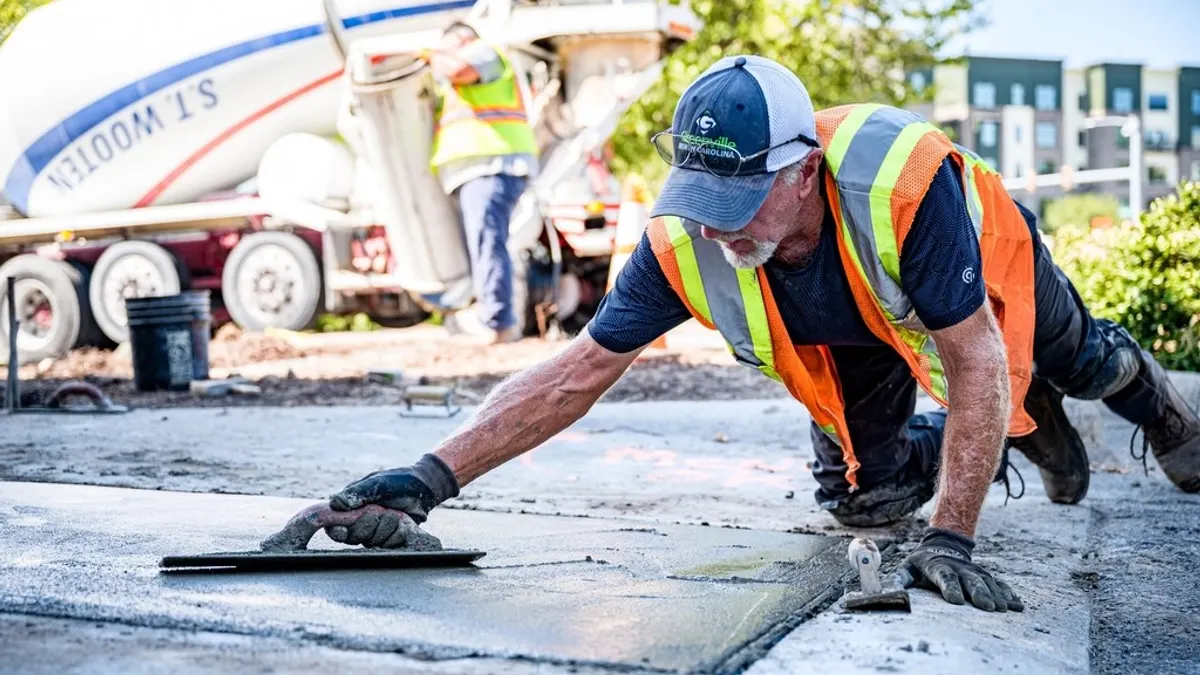
Cover photo: Pouring Sidewalks Public Works crew, CC0 1.0, via rawpixel. Cropped.
Related guides
Concrete Block Calculator: How Many Cinder Blocks and Bags of Mortar
Blocks, 80 lb bags of mortar mix and courses for a standard 8 x 8 x 16 block wall.
Concrete Calculator: Cubic Yards and Bags for Slabs, Footings and Post Holes
Volume in cubic feet and yards, bag counts by size, and the weight of the wet concrete.
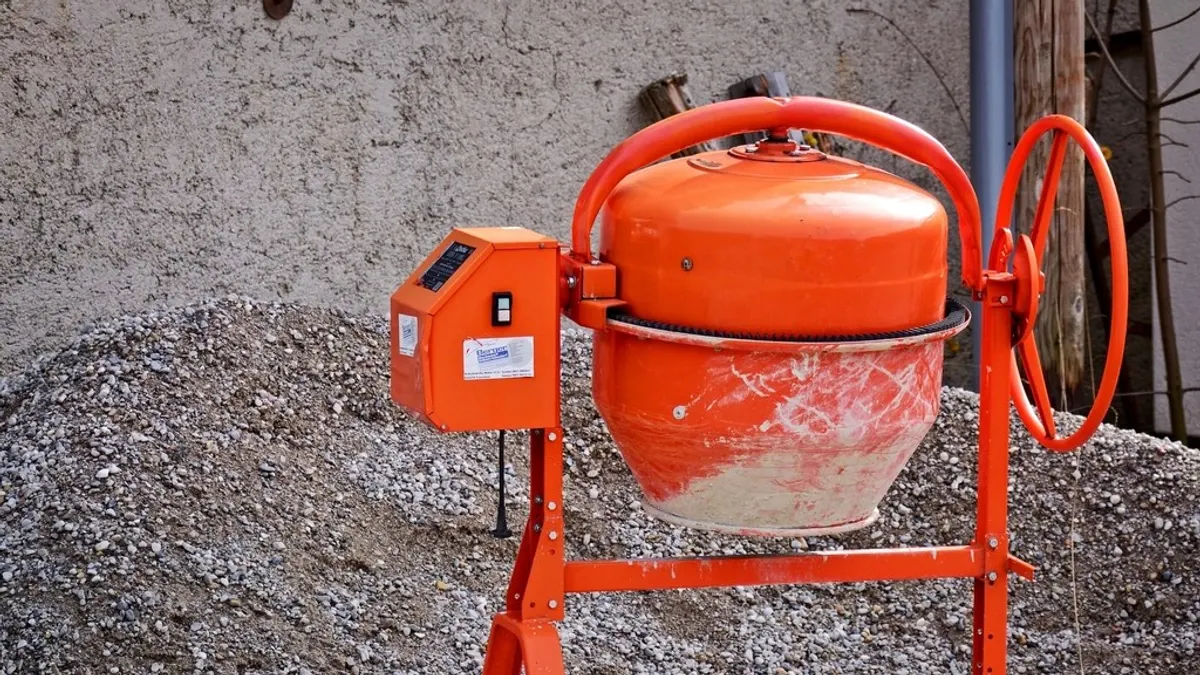
Concrete Mixers for Home Projects: Drum and Poly Drum Cement Mixers (2026)
Five electric drum mixers, how many bags each really takes, and steel vs poly drums.